Concrete Calculator
Estimate concrete volume, bags required and material cost for slabs, circular pads, piers and post holes.
- Project type: Slab / Rectangle
- Wastage allowance: 10%
- Bag yield: 25 kg bag ≈ 0.012 m³
- Bag counts are rounded up to the next whole bag.
- Results are for planning and estimation purposes only — not a structural specification.
Use this concrete calculator to estimate how much concrete you need for slabs, circular pads, piers and post holes. Enter your dimensions, choose metric or imperial units, add a wastage allowance, then estimate concrete volume, bags required and optional material costs.
For structural slabs, foundations or load-bearing work, always check the specification with a qualified professional. For a patio-specific estimate including sub-base and reinforcement, use our concrete patio calculator.
PRO TIP: For small jobs, bags may be convenient. For larger pours, ready-mix can save time, labour and mixing effort, especially once the job needs dozens of bags.
How to Use this Concrete Calculator
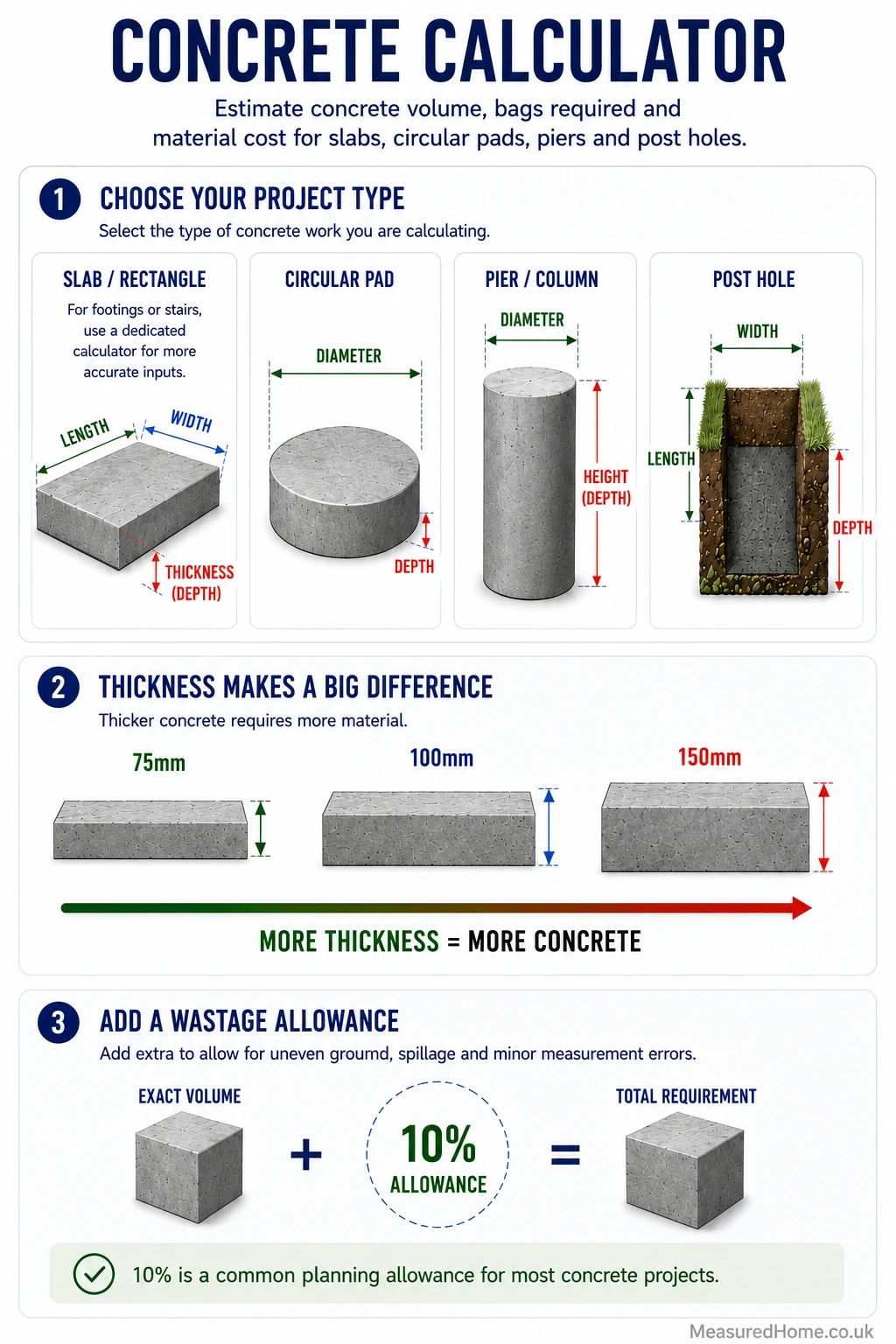
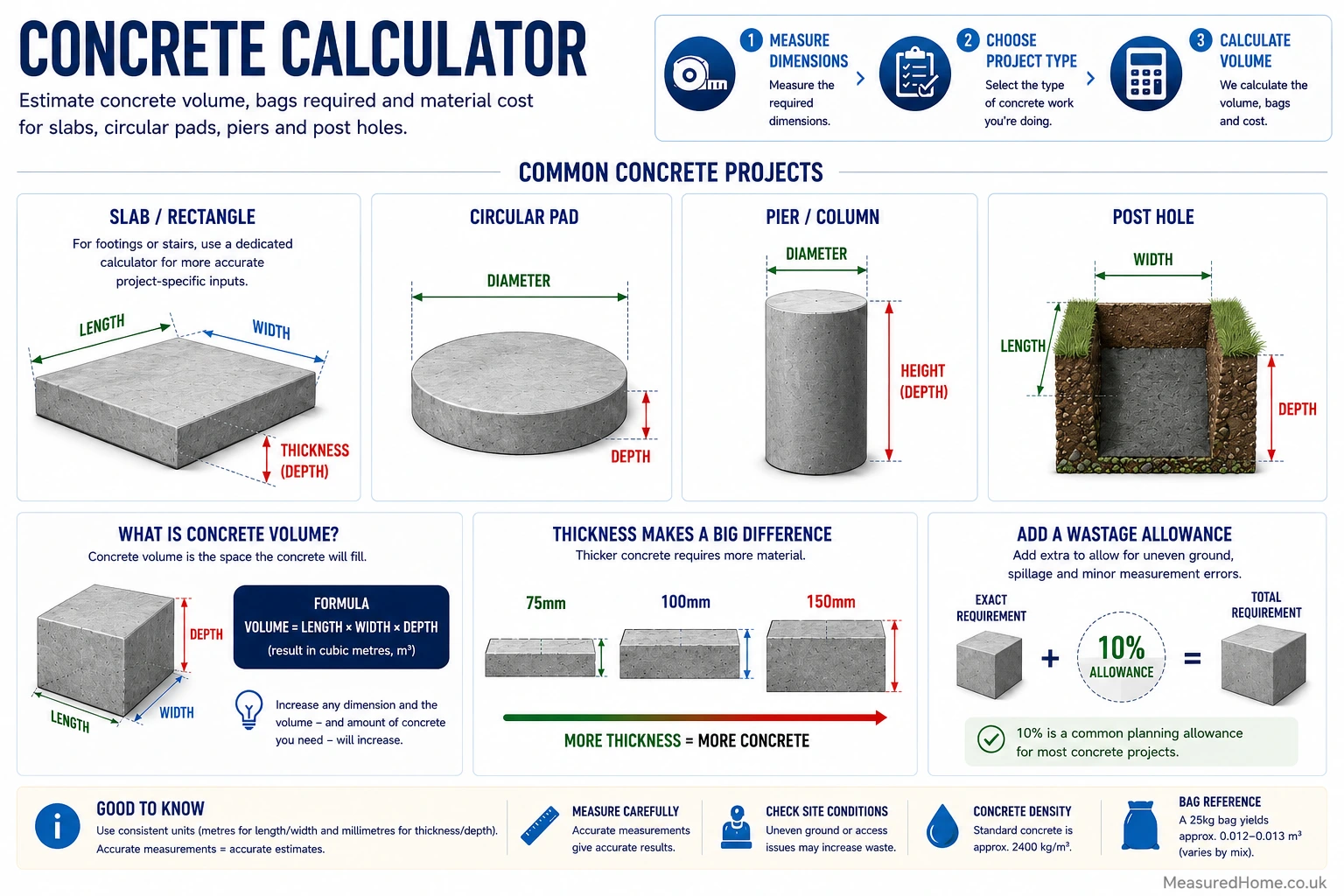
Select the type of concrete job: Slab / Rectangle, Circular Pad, Column / Pier or Post Holes.
Enter the required measurements. Metric users can enter metres and millimetres. Imperial users can enter feet, inches and cubic yard pricing where relevant.
Set the quantity. Use this for multiple matching slabs, piers or post holes.
Choose a wastage allowance. The default is 10%, which helps cover uneven ground, small measuring errors and spillage.
Select a concrete bag size. The calculator includes 20 kg, 25 kg, 30 kg, 40 kg, 50 lb, 60 lb and 80 lb bag presets, plus a custom bag yield option.
Add optional pricing to compare the estimated bag cost against the ready-mix cost.
Results Explanation
The Base Volume is the concrete needed before wastage. The Volume With Wastage is the recommended planning amount. Total Bag Weight shows the approximate total bag weight when a preset bag size is used. Ready-Mix Volume shows the same required volume for ordering ready-mix concrete.
Bag quantities are rounded up because concrete bags can only be bought as whole bags. For a more detailed bag estimate including supplied volume, leftover concrete and total weight, use our concrete bags calculator.
How the Maths Works
For a slab, the calculator uses:
length × width × thickness
For a circular pad, it uses:
π × radius² × thickness
For piers and post holes, it treats each one as a cylinder:
π × radius² × height or depth
It then multiplies by the quantity and adds wastage:
base volume × (1 + wastage % ÷ 100)
Bags required are calculated by dividing the final volume by the selected bag yield, then rounding up:
volume with wastage ÷ m³ per bag
Cost is calculated from either:
bags required × cost per bag
or:
ready-mix volume × price per m³ / yd³
The built-in 25 kg bag preset uses an estimated yield of 0.012 m³ per bag.
Common Mistakes to Avoid
Do not forget to convert slab thickness into millimetres when using metric inputs.
Do not skip wastage, especially for hand-dug holes, uneven ground or awkward access.
Do not assume every bag has the same yield. Check the mixed yield on the bag or supplier datasheet.
Do not use this calculator as a structural design tool. Footings, reinforced slabs and load-bearing concrete need proper specification. For strip, pad or round footings, use our concrete footing calculator for a more project-specific estimate.
Do not pour concrete in poor weather without precautions. Cold weather can slow curing, and concrete should be protected from freezing early on. CEMEX advises keeping concrete above 5°C for the first 48 hours in cold conditions.
faqs
How thick should a concrete slab be for a shed base or patio?
For light domestic uses such as paths, patios, and shed bases, common slab thicknesses are often around 75–100 mm. Heavier use, such as garages or driveways, may need thicker concrete and better sub-base preparation. Heidelberg Materials gives 75–100 mm for lighter slabs and at least 100 mm for driveways and garages as a rule of thumb.
How much extra concrete should I order?
A 10% wastage allowance is a sensible starting point for many DIY jobs. Increase it if the ground is uneven, the excavation is rough, or you are filling hand-dug post holes.
Can I use this for fence post holes?
Yes. Choose Post Holes, enter the hole diameter, hole depth and number of holes. The calculator estimates the total concrete volume and bag count. If you’re setting fence posts with Postcrete rather than standard concrete, use our Postcrete calculator.
Can I pour concrete in cold weather?
You can, but it needs care. Fresh concrete should not be allowed to freeze, and cold weather slows strength gain. Use suitable protection and follow supplier guidance. Use our concrete drying and curing calculator to estimate curing milestones and drying times based on your slab and site conditions.
Do I need a sub-base under a concrete slab?
For many outdoor slabs, a compacted sub-base helps support the concrete and reduce movement. The exact build-up depends on the project, ground conditions and load.
Does the calculator include wastage?
Yes. It adds your selected wastage percentage to the base volume before calculating bags and ready-mix volume.
Why does the calculator round bags up?
Concrete bags are sold as whole bags, so the calculator rounds up to make sure you have enough.
Can I enter my own bag yield?
Yes. Select the custom bag yield and enter the mixed yield in m³ per bag.
Related calculators
Concrete Mix Calculator
Concrete Weight Calculator
Rebar calculator
Disclaimer
This calculator is for estimating concrete volume, bag quantities and material cost only. Bag yields are approximate and vary by product. Check the yield stated on your bag or manufacturer datasheet for the most accurate estimate. It is not a structural specification. Always check product datasheets, site conditions, drainage, sub-base requirements and local building requirements before starting work.
For structural concrete, foundations, retaining walls, reinforced slabs or load-bearing projects, get professional advice.