Concrete Driveway Calculator
Estimate concrete volume, sub-base material, wastage and indicative material cost for a driveway.
- Concrete thickness: 100 mm
- Wastage allowance: 10%
- Sub-base depth defaults to 100 mm if left blank.
- Sub-base tonnage uses an indicative density of 1.7 tonnes per m³; actual bulk density can vary by material, moisture and compaction.
- Results are for planning and material estimation only.
Use this concrete driveway cost calculator to estimate how much concrete you need for a driveway, including wastage and indicative material costs. Enter your driveway dimensions or known area, choose a concrete thickness, add your concrete price, and the calculator will estimate concrete volume, wastage and total material cost.
Advanced mode also lets you include sub-base depth, sub-base cost, reinforcement or mesh cost, and extra driveway sections such as widened parking bays or paths.
Front garden driveways usually need to manage rainwater through a permeable surface or drainage to a lawn, border or soakaway to avoid planning issues.
PRO TIP: For a proper driveway estimate, price the concrete separately from the full installed driveway cost. Excavation, MOT Type 1 sub-base (Use our MOT Type 1 calculator to determine the required quantity.), formwork, drainage, reinforcement, finishing, skip hire and labour can all be significant.
How to Use this Concrete Driveway Cost Calculator
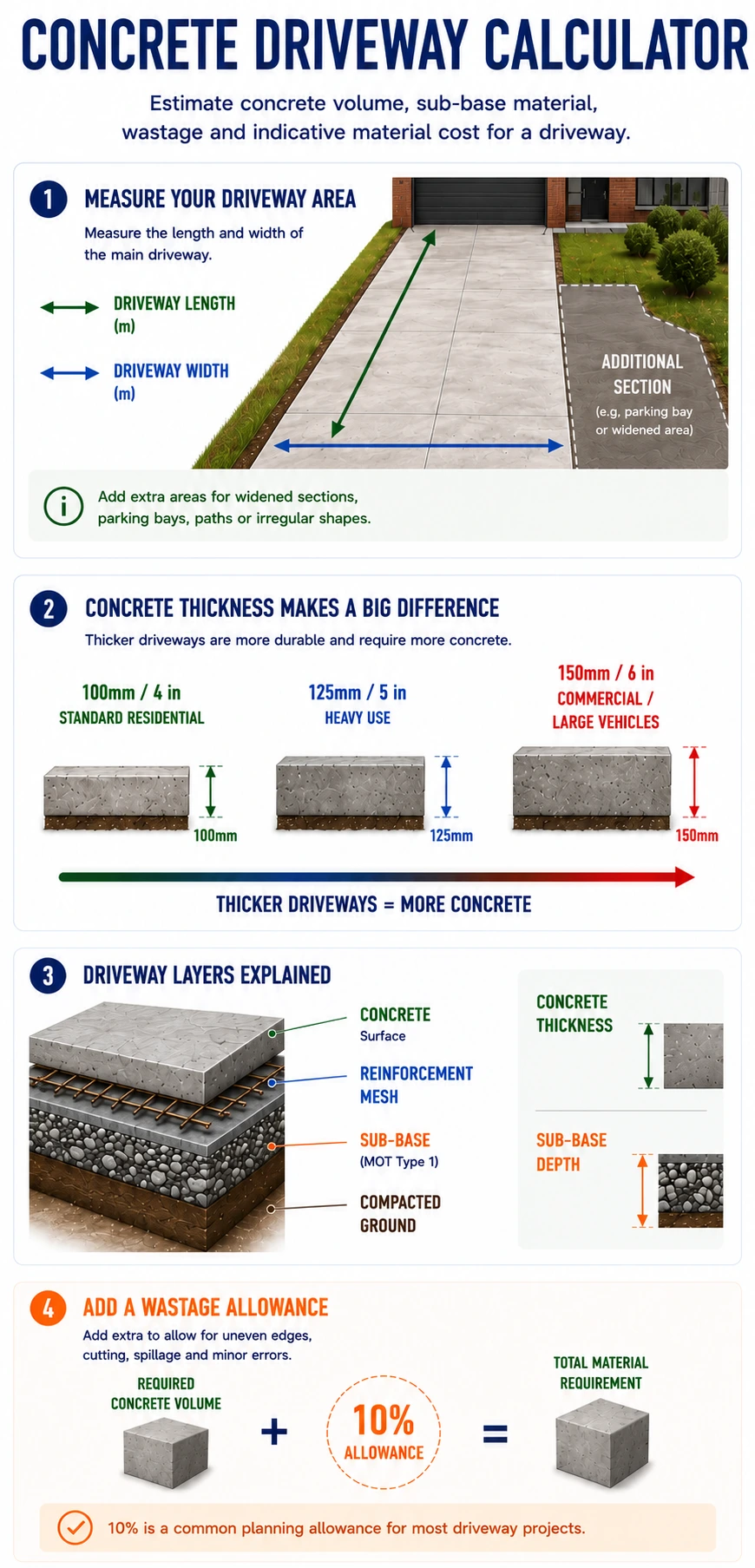
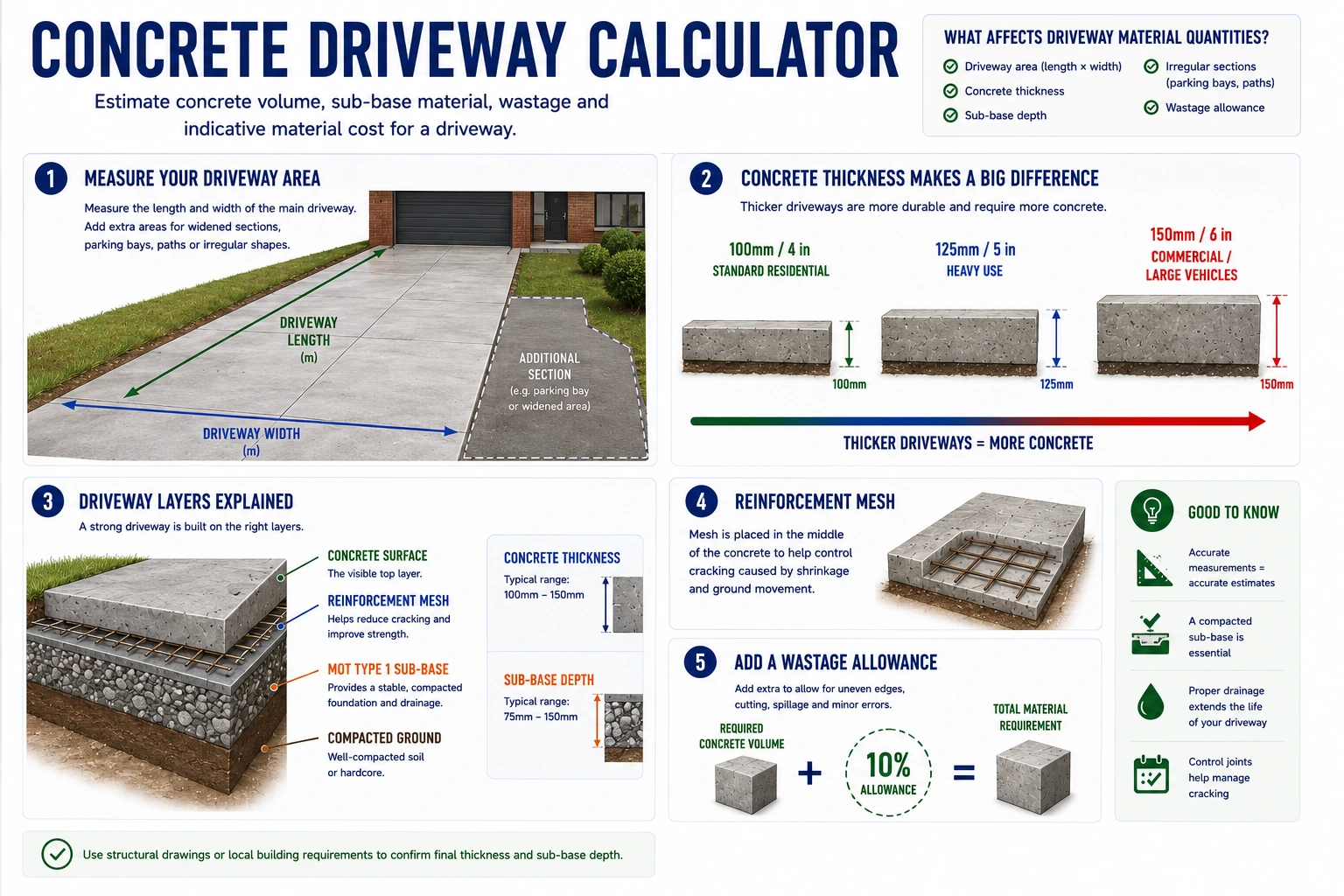
Start by selecting whether you want to calculate from driveway dimensions or a known area. For a rectangular driveway, enter the length and width. For an irregular driveway, measure the total area separately and choose the known area option.
Next, choose the concrete thickness. The tool includes 100 mm, 125 mm, and 150 mm presets, plus a custom thickness option. Many domestic concrete driveways are commonly estimated at around 100–150 mm, depending on vehicle use, ground conditions and specification.
Use the wastage field to add extra concrete. A 10% allowance is a sensible starting point, especially where the excavation is uneven, edges are irregular, or measurements are approximate.
Add your concrete price per m³. This should be the delivered concrete rate you want to use for your estimate. The calculator does not add labour, excavation, drainage, formwork, waste removal or finishing costs unless you include equivalent material rates manually.
In Advanced mode, you can add a sub-base depth and cost, reinforcement cost per m², and two additional driveway areas.
Results Explanation
The calculator shows:
Driveway area: the total measured area, including any extra sections in Advanced mode.
Concrete before wastage: the exact slab volume before adding any allowance.
Concrete with wastage: the recommended estimated volume after the wastage percentage is applied.
Wastage added: the extra volume included as a buffer.
Sub-base required: shown in Advanced mode, based on the selected sub-base depth.
Reinforcement area: shown in Advanced mode, based on total driveway area.
Material cost: the total estimated material cost from the prices you enter.
For other concrete projects such as slabs, pads, piers or post holes, use our concrete calculator.
How the Maths Works
The calculator first works out the driveway area.
For length × width:
Area = length × width
For a known area, it uses the area entered directly.
If Advanced mode extra sections are entered, they are added to the main area:
Total area = main area + section 2 + section 3
Concrete thickness is converted from millimetres into metres:
Thickness in metres = thickness mm ÷ 1000
Concrete volume before wastage is:
Concrete volume = total area × thickness
Wastage is then added:
Concrete with wastage = concrete volume × (1 + wastage ÷ 100)
For sub-base in Advanced mode, the tool uses the entered depth or defaults to 100 mm if left blank:
Sub-base volume = total area × sub-base depth
In metric mode, sub-base tonnes are estimated using a density of 1.7 tonnes per m³:
Sub-base tonnes = sub-base volume × 1.7
Material cost is calculated only when prices are entered. It can include concrete cost, sub-base cost and reinforcement cost.
Common Mistakes to Avoid
- Do not order concrete from the exact no-wastage figure. Small differences in excavation depth can change the volume quickly.
- Do not ignore drainage. Non-permeable driveway surfaces may need suitable drainage or planning permission, especially in front gardens.
- Do not assume 100 mm is suitable for every driveway. Heavier vehicles, poor ground or frequent use may need a thicker slab or professional specification.
- Do not forget sub-base preparation. A weak or uneven base can lead to cracking, settlement and poor long-term performance.
- Do not use this calculator for structural design. It is for planning and estimating materials.
- Do not assume the drying time. Once the driveway has been poured, use our concrete drying and curing calculator to estimate curing milestones and drying times.
FAQs
How much concrete do I need for a driveway?
Multiply the driveway area by the slab thickness. For example, a 30 m² driveway at 100 mm thick needs 3.0 m³ before wastage. With 10% wastage, that becomes 3.3 m³.
How thick should a concrete driveway be in the UK?
A common domestic range is around 100–150 mm, depending on vehicle weight, ground conditions and whether reinforcement is needed. Heavier vehicles may need a thicker specification.
Do I need planning permission for a concrete driveway?
You may not need planning permission if the surface is permeable or rainwater drains naturally to a lawn, border or suitable drainage area. Non-permeable front garden driveways can trigger planning requirements.
Is reinforcement needed for a concrete driveway?
It depends on the driveway design, ground conditions and expected vehicle loads. Mesh or reinforcement is often considered where extra strength or crack control is needed, but structural advice may be required. If your design specifies reinforcement, use our rebar calculator to estimate the quantity, length and weight required.
Can I use a known driveway area instead of length and width?
Yes. Select “Known Area” and enter the driveway area in m².
What does Advanced mode add?
Advanced mode adds sub-base depth, sub-base cost, reinforcement cost and two extra driveway area sections.
What happens if I leave the sub-base depth blank?
The calculator defaults to 100 mm for the sub-base depth in Advanced mode.
Related calculators
Concrete Weight Calculator
Kerb & Edging Concrete Calculator
Concrete Bags Calculator
Reinforcement Mesh Calculator
Disclaimer
This calculator is for planning and material estimation only. It does not replace a site survey, structural design, drainage assessment or supplier quote.
For front garden driveways, check drainage and planning requirements before work starts. For heavy vehicles, poor ground, steep drives or structural concerns, speak to a qualified contractor or engineer.