Concrete Ramp Calculator
Estimate concrete volume, ramp slope, surface length, wastage and indicative material cost for a concrete ramp.
- Rise is taken from the vertical height entered.
- Width is taken from the clear ramp width entered.
- Run is taken from the horizontal ramp length entered or calculated from the target slope.
- Ramp volume includes any thin-end thickness entered.
- Wastage allowance: 10%
- Slope check compares the calculated slope against the maximum desired slope.
- Landings use the recommended concrete thickness.
- Ramp purpose is used to recommend concrete thickness, sub-base and reinforcement.
- Sub-base depth defaults to the recommended depth unless changed in Advanced.
- Results are for planning and material estimation only.
Use this Concrete Ramp Calculator to estimate the amount of concrete required for a ramp, calculate slope ratios, check accessibility gradients, estimate material costs and determine sub-base requirements.
The calculator supports both metric and imperial measurements and includes estimations for concrete thickness, MOT Type 1 sub-base depth, reinforcement mesh requirements, excavation depth, landings and slope compliance checks.
PRO TIP: For wheelchair ramps and accessibility projects, check current UK Building Regulations and accessibility guidance before construction. A ramp that meets volume requirements may still be too steep for safe use.
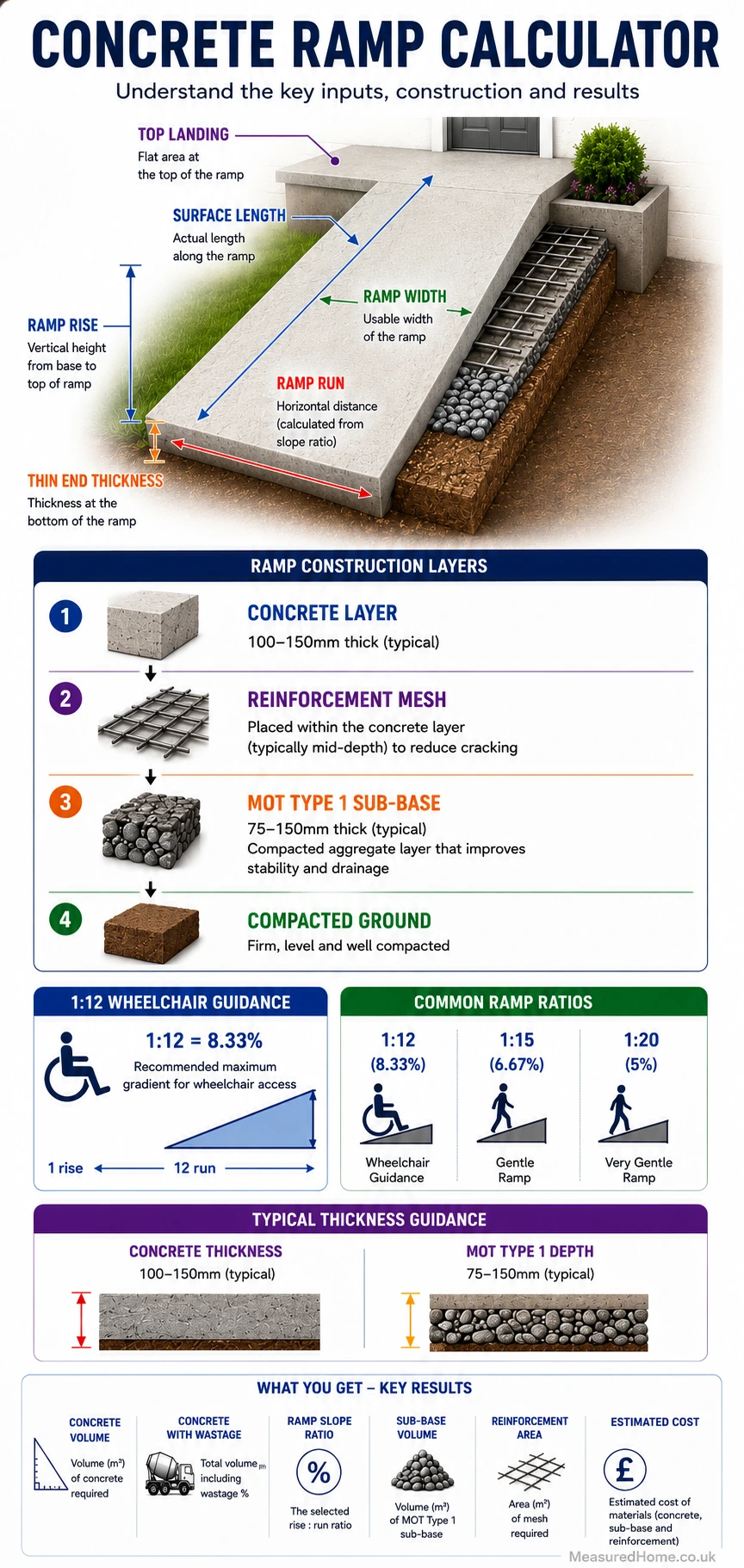
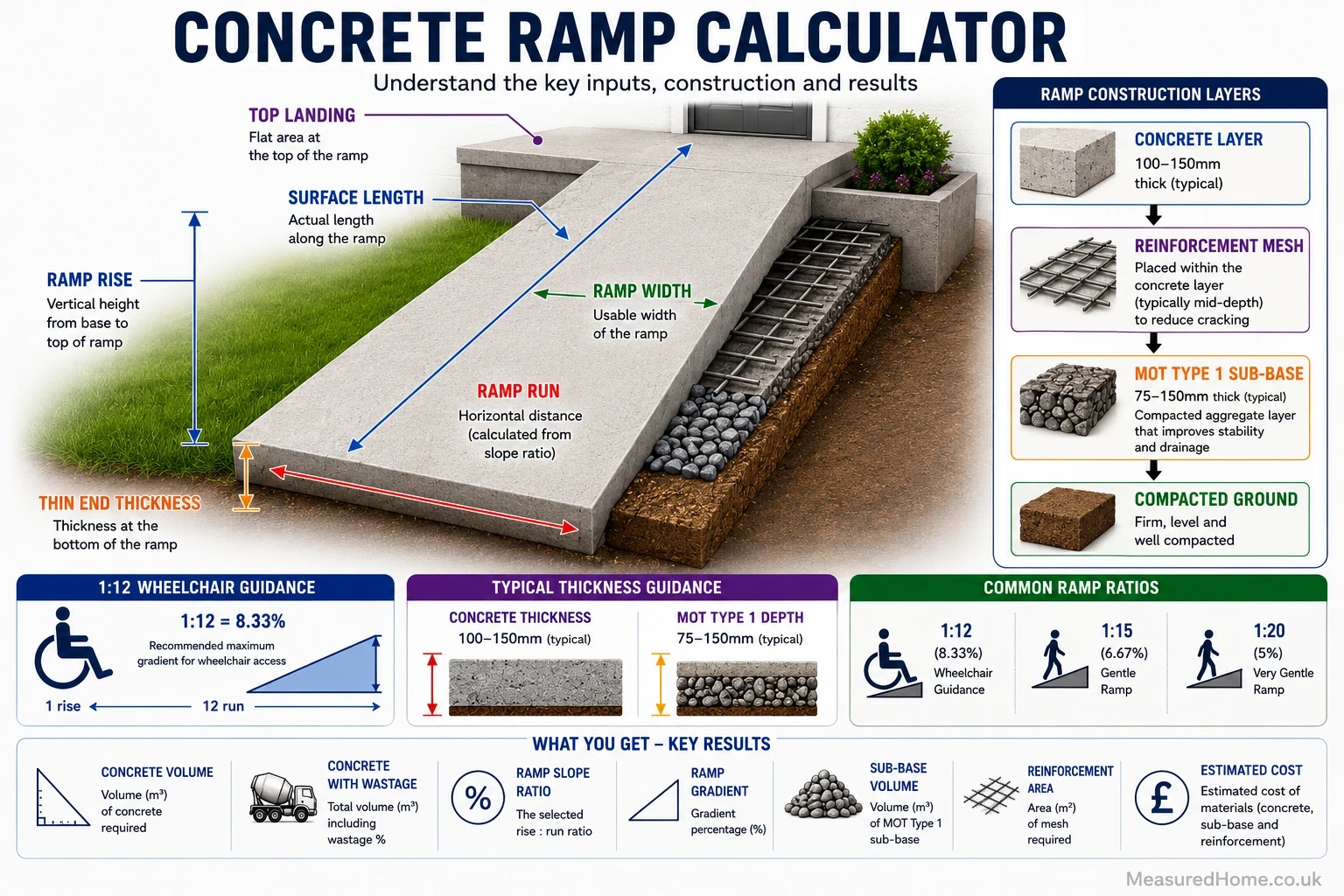
How to Use this Concrete Ramp Calculator
Enter the ramp rise, width and horizontal run. If you know the gradient you want instead, select Target Slope Ratio and choose 1:12, 1:15, 1:20 or enter a custom ratio. The calculator will work out the required horizontal run.
If the ramp starts from an existing slab or base, enter the thin-end concrete thickness. Leave this at zero for a standard wedge-shaped ramp.
Add a wastage allowance for spillage, uneven ground and site adjustments, then enter any concrete, sub-base or reinforcement prices you want included in the cost estimate.
Use Advanced mode to add top or bottom landings, change the sub-base depth, calculate reinforcement and excavation quantities, round the concrete order quantity or set a maximum slope.
Results Explanation
| Ramp Run | The horizontal distance covered by the ramp from start to finish. |
| Surface Length | The actual distance travelled along the ramp surface. This is always slightly longer than the horizontal run because it follows the slope. |
| Slope Ratio | The ramp gradient is expressed as 1:X For example: 1:12 means the ramp rises 1 metre vertically for every 12 metres of horizontal run. |
| Grade Percentage | The ramp slope is expressed as a percentage. This is calculated by dividing the rise by the run and multiplying by 100. |
| Ramp Angle | The angle of incline is measured in degrees. Steeper ramps produce larger angles. |
| Ramp Volume Before Wastage | The calculated concrete volume required for the ramp section only, excluding any landings and wastage allowance. |
| Landing Volume | Additional concrete volume required for any top or bottom landings entered in Advanced Mode. |
| Concrete Before Wastage | The combined concrete volume for the ramp and any landings before wastage is added. |
| Concrete With Wastage | The final concrete quantity after applying the selected wastage allowance. This is typically the volume used when ordering ready-mix concrete. |
| Wastage Added | The additional concrete volume included to account for spillage, uneven ground, over-excavation and site adjustments. |
| Recommended MOT Type 1 | The estimated quantity of MOT Type 1 aggregate required beneath the ramp is based on the ramp footprint and sub-base depth used in the calculation. |
| Mesh Required | The approximate reinforcement mesh coverage area required for the ramp and any landings. This figure represents the coverage area rather than the number of mesh sheets required. |
| Recommended Concrete Thickness | The suggested concrete thickness is based on the selected ramp purpose. Vehicle and commercial ramps generally require thicker concrete than pedestrian and wheelchair ramps. |
| Recommended Sub-base Depth | The suggested compacted MOT Type 1 depth for the selected ramp purpose. Different ramp types require different levels of support depending on expected loading. |
| Sub-base Depth Used | The actual sub-base depth used in the calculations. If a custom depth is entered in Advanced Mode, this may differ from the recommended depth. |
| Reinforcement Recommendation | A guidance recommendation based on the selected ramp purpose. Some ramps may not require reinforcement, while vehicle and commercial ramps typically benefit from reinforcement mesh. |
| Excavation Depth | The total construction depth is calculated from the concrete thickness and sub-base depth. This helps estimate how deep the ground may need to be excavated before construction. |
| Excavation Volume | The estimated volume of material that may need to be excavated to install the ramp and supporting layers. This can be useful when estimating spoil removal and groundworks. |
| Material Cost | The estimated total material cost is based on any concrete, sub-base and reinforcement prices entered into the calculator. |
| Estimated Bags | The approximate number of 25kg concrete bags required when using bagged concrete instead of ready-mix. Bag estimates are rounded up to ensure sufficient material is available on site. |
UK Wheelchair Ramp Gradient Guidance
In England, Approved Document M gives guidance on access to and use of buildings. For ramped access, the maximum gradient depends on the horizontal slope of each ramp flight. A shorter ramp may be steeper, but longer ramps should be gentler. Approved Document M lists the following limits:
| Ramp Going | Maximum Gradient | Maximum Rise |
|---|---|---|
| 10m | 1:20 | 500mm |
| 5m | 1:15 | 333mm |
| 2m | 1:12 | 166mm |
For ramp lengths between these values, the guidance allows interpolation. For example, a ramp with a 4m going may use a gradient around 1:14, while a 9m going may use a gradient around 1:19. Steeper gradients can make wheelchair access more difficult and may not meet accessibility requirements.
If steps are being considered instead of a ramp, use our concrete stairs calculator to estimate riser layout, concrete volume, landings and material quantities.
What do 1:12, 1:15 and 1:20 mean?
A ramp gradient of 1:12 means the ramp rises 1 unit vertically for every 12 units of horizontal run. For example, a 300mm rise would need a 3.6m run at 1:12.
- 1:12 – Steepest commonly referenced wheelchair ramp gradient, usually only suitable for short rises.
- 1:15 – Gentler and often more practical where space allows.
- 1:20 – Very gentle; generally easier to use and often treated more like a sloped approach than a steep ramp.
When are landings needed?
Level landings should normally be provided at the top and bottom of a ramp, and between ramp flights where the total rise or ramp length requires a break. Landings give wheelchair users, mobility scooter users and pedestrians a safe resting and turning area.
If the ramp has a high total rise, multiple flights with intermediate landings may be needed. For public, commercial or regulated access routes, confirm the required landing sizes, handrails, edge protection and surface finish against the current Building Regulations and project-specific access requirements.
Building Regulations and accessibility checks
For wheelchair access, check the latest Approved Document M guidance, any relevant local Building Control requirements and the specific needs of the building users before construction.
Concrete ramps should also be designed with suitable sub-base support, reinforcement where required, drainage, slip-resistant surface finish and edge protection. A brushed concrete finish is commonly used to improve grip, especially outdoors.
Important: If the ramp is for a public building, commercial premises, rented property, workplace or formal disabled access route, get the design checked by a competent professional or Building Control before pouring concrete.
How the Maths Works
The calculator uses the ramp rise and horizontal run to calculate the slope, surface length and concrete volume.
For a target slope ratio:
Ramp run = rise × slope ratio
The sloping surface length is calculated using Pythagoras:
Surface length = √(run² + rise²)
Concrete volume is calculated from the ramp width and average concrete depth:
Average depth = thin-end thickness + (rise ÷ 2)
Ramp volume = run × width × average depth
Any landing volume is added before the selected wastage allowance is applied:
Total concrete = concrete volume × (1 + wastage %)
The calculator also uses the rise and run to calculate the slope ratio, grade percentage and ramp angle.
Sub-base volume is calculated from its area and depth, using an assumed density of 1.7 tonnes per m³. Bag quantities use an assumed yield of 0.0125 m³ per 25 kg bag and are rounded up to the next whole bag.
For a more detailed bag estimate including supplied volume, total weight and leftover concrete, use our concrete bags calculator.
Common Mistakes to Avoid
- Confusing rise with surface length
- Measuring the slope instead of the horizontal run
- Forgetting to include landings
- Using no wastage allowance
- Ignoring sub-base requirements
- Ordering exact quantities with no contingency
- Failing accessibility slope requirements
- Omitting reinforcement where ground conditions require it
FAQs
How much concrete do I need for a ramp?
The required volume depends on the ramp rise, width, run length and any landings. This calculator estimates the total concrete volume automatically.
What is the recommended slope for a wheelchair ramp?
A 1:12 slope is commonly used for accessibility ramps, although project-specific requirements may vary.
How thick should a concrete ramp be?
Domestic pedestrian and wheelchair ramps commonly use around 100mm of concrete. Mobility scooter ramps often use around 125mm, while vehicle and commercial ramps typically use around 150mm or more. Actual requirements depend on loading, ground conditions and local regulations.
Do I need reinforcement mesh?
Many ramps benefit from reinforcement to help reduce cracking and improve durability. If your ramp specification includes mesh, use our reinforcement mesh calculator to estimate the number of sheets, overlaps and wastage required.
What sub-base depth should I use?
A typical sub-base depth is around 100mm, although heavier loads may require deeper construction.
What happens if my ramp is too steep?
The advanced slope check highlights whether the calculated ramp exceeds your selected maximum slope ratio.
How much MOT Type 1 do I need under a concrete ramp?
Most residential concrete ramps require a compacted MOT Type 1 sub-base beneath the concrete. The calculator estimates the quantity required based on the ramp footprint and selected construction depth.
Why does the calculator show excavation depth?
Excavation depth helps estimate how much ground must be removed before installing the sub-base and concrete layers. This is useful when planning labour, spoil removal and overall project costs.
Related Calculators
Concrete Driveway Calculator
Concrete Calculator
Concrete Weight Calculator
Concrete Drying & Curing Calculator
Disclaimer
- Results are intended for planning and estimating purposes only.
- Site conditions may affect actual material requirements.
- Concrete yields vary by mix design and supplier.
- Accessibility requirements should be verified against current regulations.
- Structural projects may require professional design and approval.
- Always confirm quantities with suppliers before ordering.