Block Calculator
Estimate concrete blocks for your wall — from simple DIY projects to full trade builds.
- Standard UK block face: 440 × 215 mm
- Mortar joint thickness: 10 mm
- Wastage allowance: 5%
- Blocks per pallet: 72
- Mortar bag estimate: approx. 3 bags per 100 blocks (25 kg bags)
Use this block calculator to estimate how many concrete blocks you need for a wall based on the wall dimensions, block size, and mortar joint thickness. The calculator helps you work out the total number of blocks required, including optional wastage.
For projects where the wall will retain soil or other material, use our retaining wall calculator to estimate the blocks and other materials required.
Simply enter the wall height and wall length, select your block size, and adjust the mortar joint thickness if needed. The calculator will then estimate the total number of blocks required for your wall area.
This block calculator is based on standard UK block sizes and typical blockwork practices used by builders, tradespeople, and DIY enthusiasts.
PRO TIP: When ordering blocks, always round up to full packs or pallets. It’s difficult to match blocks from different batches, and slight variations in size or finish can affect both appearance and build quality.
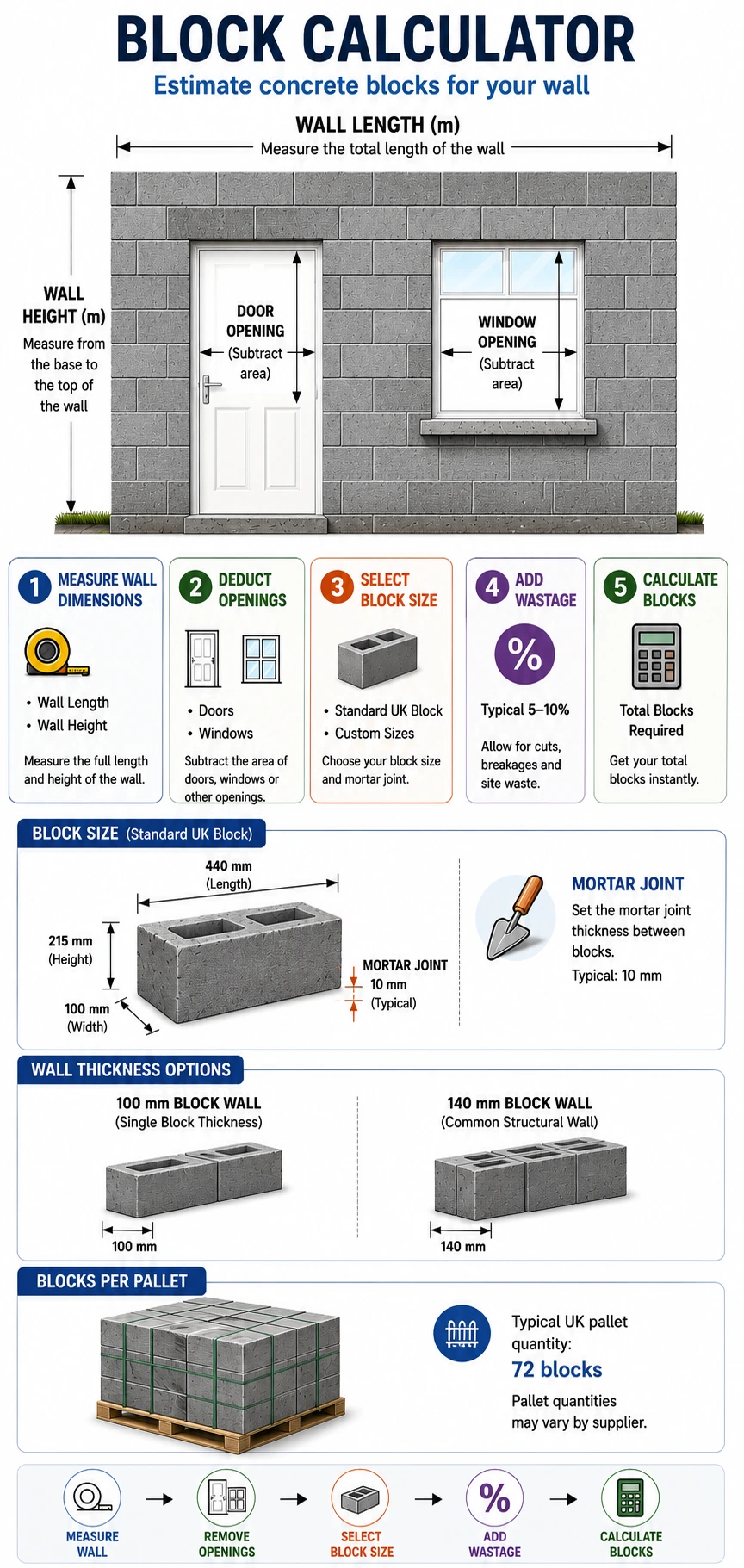
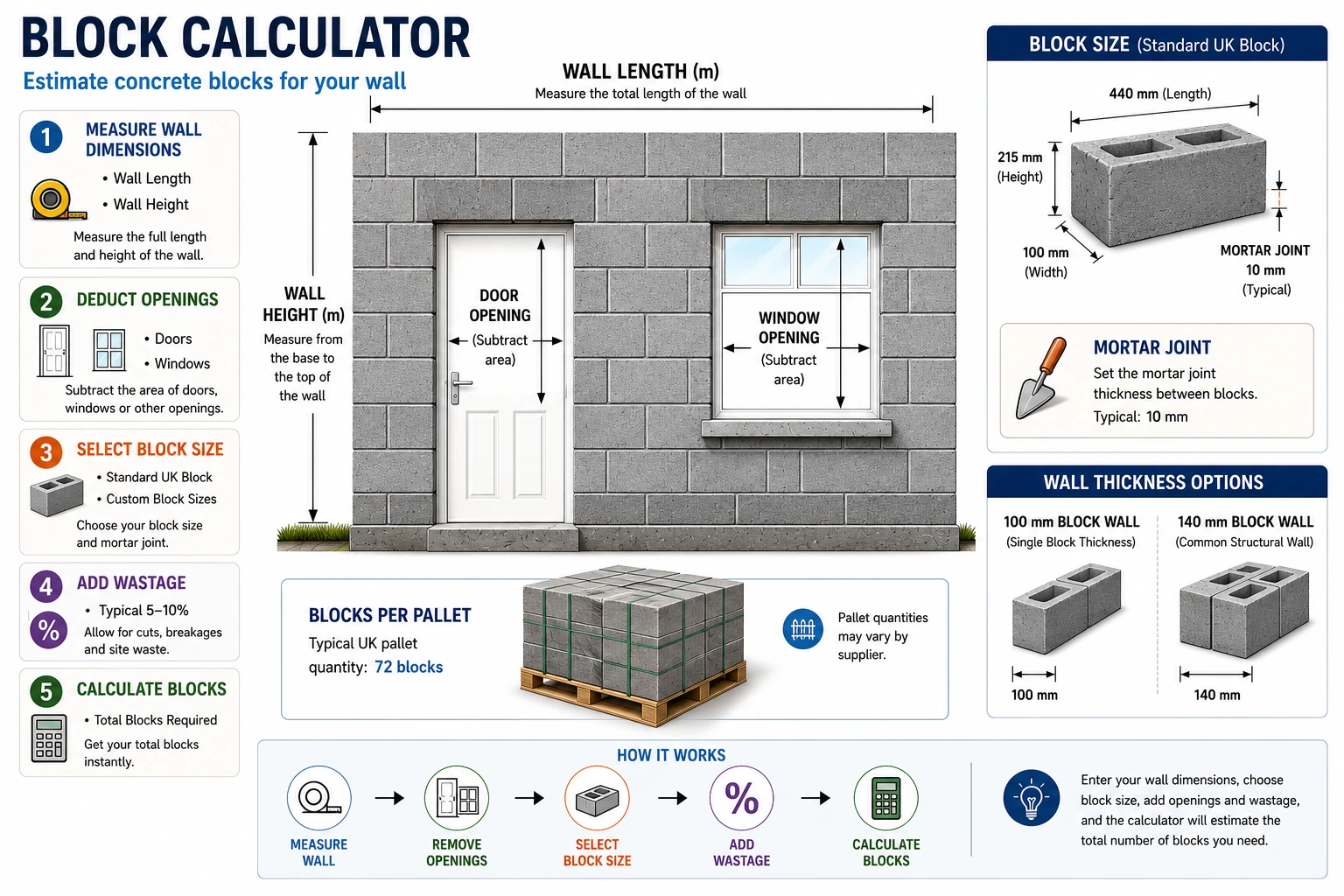
How to use the block calculator
1. Enter the wall length and height
2. Select your block size or enter custom dimensions
3. Add any openings such as doors or windows (optional)
4. Adjust wastage percentage if needed
5. Click calculate to see your results
The calculator will instantly show:
– Total blocks required
– Blocks including wastage
– Estimated mortar requirements
– Optional cost estimates
How many blocks do I need?
To calculate how many concrete blocks you need, you first need to work out the total wall area and the size of each block.
The basic calculation is:
Wall area = wall height × wall length
Blocks needed = wall area ÷ block area
For example, a wall that is 5m long and 2m high has an area of 10m². If each block covers 0.1m², you would need approximately 100 blocks before adding wastage.
This calculator does all of this instantly, including adjustments for mortar joints and waste. If you would like to estimate quantities of mortar required for your project, try our mortar calculator.
If your project uses traditional bricks instead of concrete blocks, you can use our brick calculator to estimate quantities based on standard UK brick sizes.
How to calculate concrete blocks
Concrete block calculations are based on a few simple steps:
- Measure the wall dimensions (height and length)
- Calculate the total wall area
- Determine the size of the block being used
- Divide the wall area by the block area
- Add a wastage allowance (typically 5–10%)
Standard block sizes (UK)
The most common concrete block size in the UK is:
- 440mm × 215mm × 100mm
Other common variations include:
- 440mm × 215mm × 140mm
- 440mm × 215mm × 215mm
Block size affects how many blocks you need per square metre. A standard UK block typically results in around 9–10 blocks per m² when including mortar joints.
This calculator allows you to select standard sizes or enter custom dimensions depending on your project.
Mortar, wastage and materials
When estimating materials, it’s important to account for mortar and wastage.
Mortar joints are typically around 10mm thick and affect how blocks are spaced. This changes the number of blocks required per square metre.
Wastage should also be included to cover:
- Broken blocks
- Cutting and trimming
- On-site errors
A typical wastage allowance is 5–10%.
For mortar estimation:
- Approximately 3 standard bags of mortar are needed per 100 blocks
Deducting Doors and Windows (Openings)
When calculating how many concrete blocks you need for a wall, it’s important to deduct any openings such as doors, windows or large gaps. These areas do not require blocks, so including them in the total wall size will lead to overestimating materials.
To calculate this accurately, start by working out the full wall area using the total height and length. Then subtract the area of each opening to get the true blockwork area.
Adjusted wall area = Total wall area − Openings area
For example, if your wall is 12 m² and you have a window and door with a combined area of 3 m², the effective wall area becomes 9 m². This adjusted figure is then used to calculate how many blocks are required.
If you are using the Advanced mode in this calculator, you can enter openings directly, and the deduction will be applied automatically.
If you’re calculating a complete cavity wall, use our cavity wall calculator to estimate the bricks, blocks, insulation, wall ties and mortar required together.
Block cost estimator
To estimate the total cost of your project, multiply the number of blocks required by the price per block.
Total cost = number of blocks × price per block
Block prices vary depending on:
- Block type (dense, lightweight, aerated)
- Size and strength rating
- Supplier and location
FAQs
How many blocks per m²?
A standard UK concrete block typically results in around 9–10 blocks per square metre, depending on mortar joint thickness.
How many concrete blocks do I need?
You can calculate this by dividing your wall area by the area of a single block, then adding 5–10% for wastage. This calculator does it automatically.
How much mortar do I need for blockwork?
As a general rule, around 3 bags of mortar are required per 100 blocks. This can vary depending on joint thickness and block type.
What is the standard block size in the UK?
The most common size is 440mm × 215mm × 100mm, although other sizes are also widely used.
Why does my block calculation differ from a builder’s quote?
It’s common for builder estimates to be higher than a basic calculation because professionals typically factor in additional wastage from cuts and breakages, allow for extra materials needed around corners, returns, and detailing, and account for site conditions and handling losses.
Related calculators
Concrete Footing Calculator
Render Calculator
Disclaimer
This calculator provides estimates for informational purposes only and does not constitute professional advice. Actual material requirements may vary based on site conditions, construction methods, and block dimensions and product variations. Always consult with a qualified professional or your material supplier before placing an order.