Repointing Calculator
Estimate mortar volume, sand, cement or lime quantities, and optional material costs for brick and stone repointing.
- Standard UK brick joint pattern assumed
- Joint width 10 mm and raking depth 15 mm
- Mortar type and mix split based on selected preset
- 10% wastage allowance applied
- Openings are deducted from the wall area where entered.
- Ready-mix bag quantities use the yield entered above. Replace the planning default with the selected product’s declared mixed yield before purchase.
- Older buildings may require softer lime-based mortar and a test panel before full repointing.
- Results are for planning and estimation purposes only and should not replace site assessment or conservation advice.
Use this repointing calculator to estimate how much mortar you need for brick or stone walls, including sand, cement, lime and optional material costs. It is useful for patch repairs, garden walls, chimneys and older masonry where getting the right mortar quantity matters.
The calculator works for both metric and imperial measurements, lets you subtract openings such as doors and windows, and includes an advanced mode for additional wall sections and pointing style adjustments. It is designed for planning and buying materials, not for replacing a site inspection or conservation advice on older buildings.
PRO TIP: For older brick or stone walls, measure a small trial section first and compare the calculator estimate against actual use. Irregular joints, deep raking and soft masonry can push mortar demand above a standard brickwork estimate. If you’re planning new brickwork rather than repairing existing joints, use our brick calculator to estimate the bricks required.
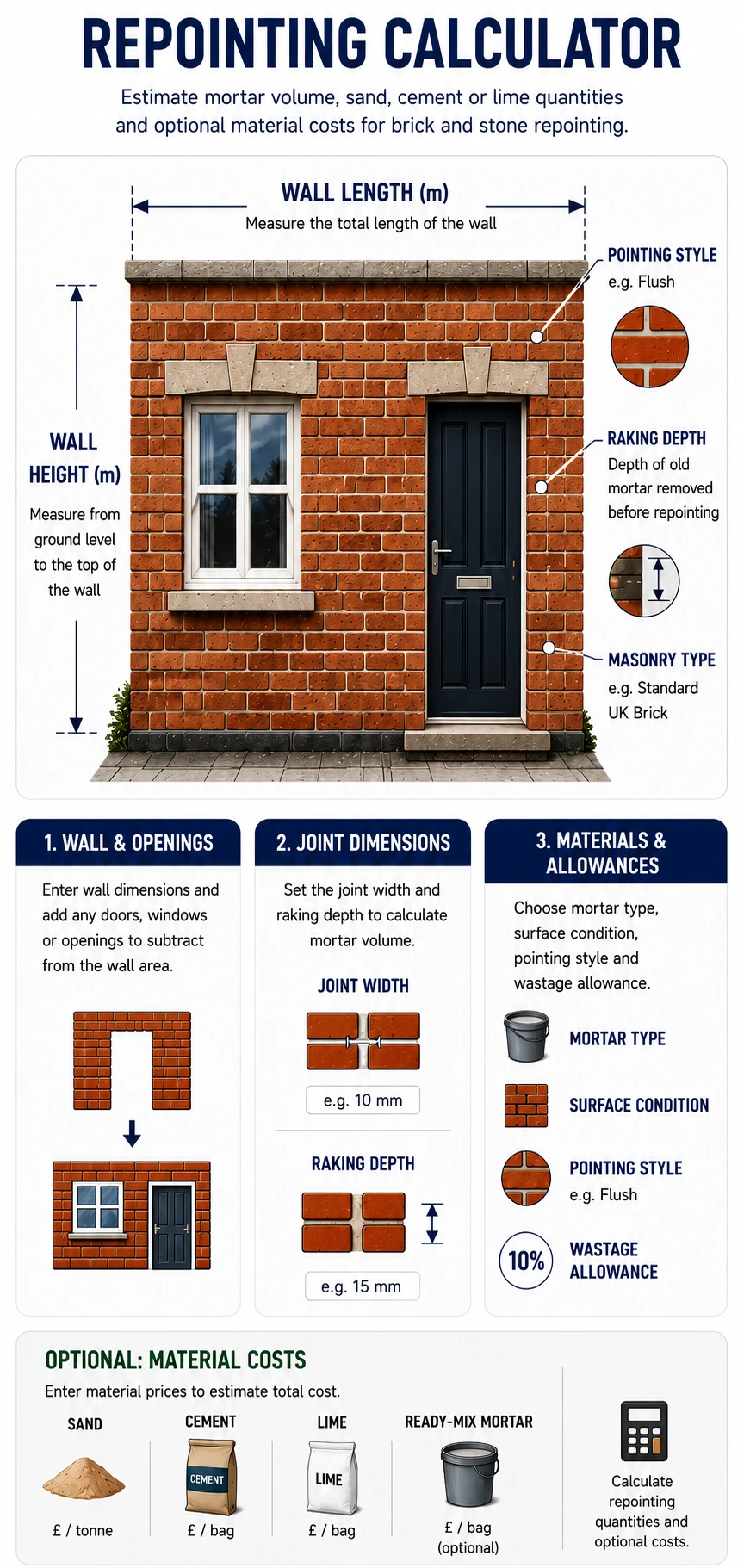
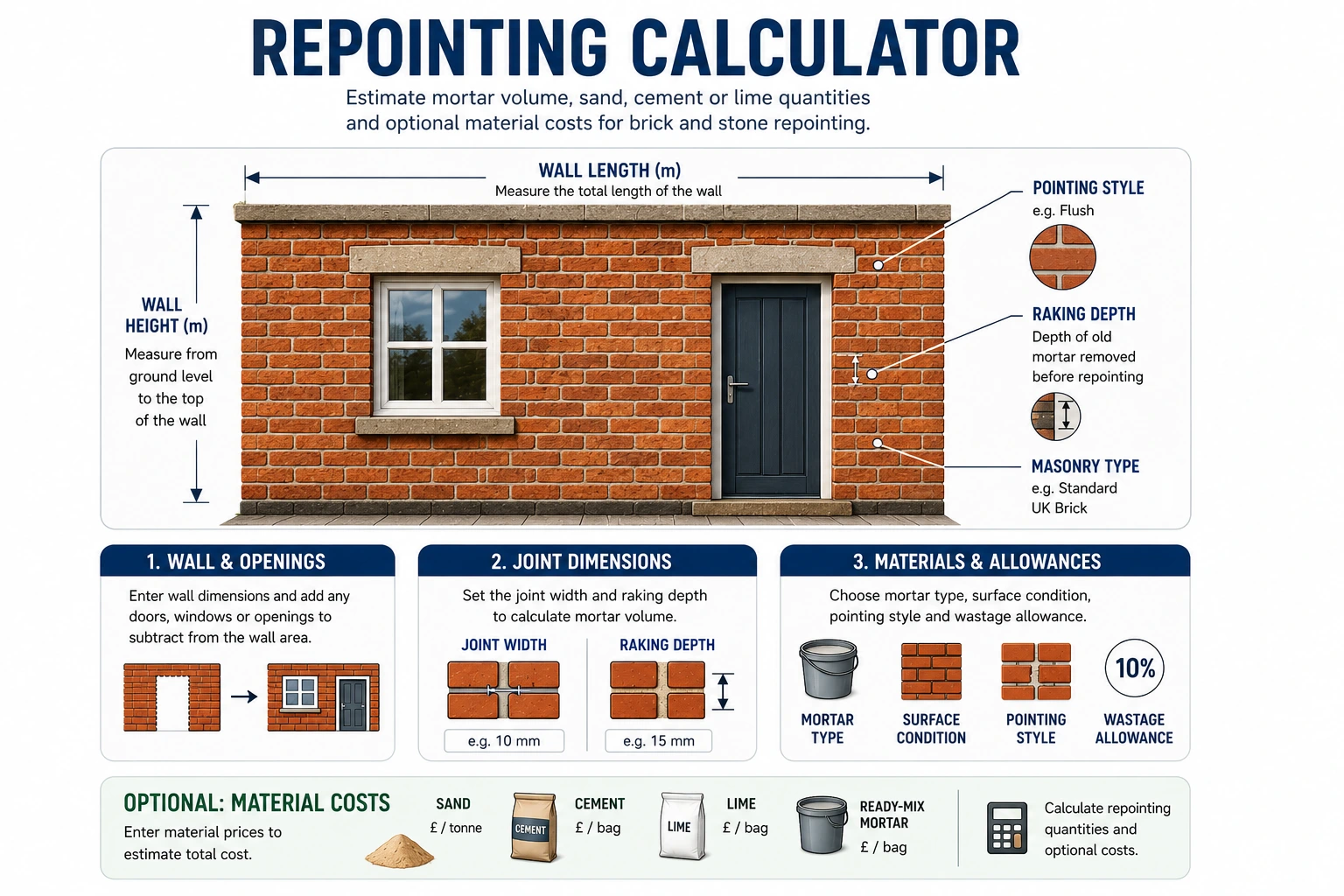
How to Use the repointing calculator
Start by entering the size of the wall you want to repoint. You can switch between metric and imperial units at the top of the calculator.
If the wall includes windows, doors or other openings, add them so the calculator can subtract that area from the total.
Next, choose the masonry type. Standard UK brick and imperial brick use built-in dimensions, while stone and irregular masonry apply a heavier joint-use assumption. If your units are unusual, choose Custom Unit Size and enter the unit length and height in millimetres.
Then enter:
- Joint width
- Raking depth
- Mortar type
- Surface condition
- Wastage percentage
In advanced mode, you can also:
- Choose a pointing style
- Add extra wall sections for extensions, garages or split elevations
Finally, you can enter optional prices for sand, cement, lime and ready-mix mortar to get a materials-only cost estimate.
Results Explanation
Gross Wall Area is the full area of all wall sections before deductions.
Openings Area is the total area of doors, windows and other openings you entered.
Net Wall Area is the area actually used for the mortar estimate after subtracting openings.
Mortar Volume is the estimated volume of mortar needed to refill the raked-out joints.
Mortar Required converts that volume into litres for easier buying and planning.
Sand Required, Cement Required and Lime Required show the estimated raw material quantities based on the mortar mix you selected.
Wastage shows the extra allowance added for spoil, uneven joints, overfill and general site loss.
Coverage Per Bag shows the assumed yield for ready-mix mortar bags.
Ready-Mix Bags estimates how many pre-bagged mortar bags you would need if using a ready-mix option.
Total Estimated Cost appears when you enter one or more material prices.
How the Maths Works
- The calculator converts all measurements to metres.
- It works out the gross wall area by multiplying wall length by wall height, then adds any extra wall sections in advanced mode.
- It subtracts the total area of any openings to get the net wall area.
- It estimates how much of that wall face is mortar joint rather than brick or stone by using the selected masonry size and joint width.
- It multiplies that joint-area share by the raking depth to estimate the base mortar volume.
- It adjusts the base volume using:
- a masonry factor
- a surface condition factor
- An optional pointing style factor in advanced mode
- It adds the selected wastage percentage.
- It converts the final mortar volume into litres.
- It applies the selected mortar mix:
- Lime Mortar: 1 part lime: 2.5 parts sand
- Cement-Lime-Sand: 1 part cement: 1 part lime: 6 parts sand
- Cement-Sand: 1 part cement: 4 parts sand
For general mortar quantities and mix calculations for new brickwork or blockwork, use our mortar calculator.
- It converts those mixed parts into estimated tonnes of sand and bags of cement or lime.
- If you enter prices, it calculates a materials cost based on raw materials, ready-mix, or both.
Common Mistakes to Avoid
- Measuring the whole wall but forgetting to deduct windows and doors
- Using modern cement-rich mortar on older walls that may need a softer, more breathable lime-based mix
- Guessing joint width instead of measuring it in several places
- Underestimating raking depth
- Using too little wastage on uneven brick or stonework
- Treating ready-mix bag counts as an exact site yield rather than an estimate
- Repointing in poor weather, especially frost, driving rain or rapid drying conditions, which can cause failure
FAQs
What does the repointing calculator actually estimate?
It estimates mortar volume, mortar required in litres, sand quantity, cement bags, lime bags, ready-mix bags and optional materials cost.
Does the calculator deduct windows and doors?
Yes. You can add openings, and the calculator subtracts their area from the gross wall area before estimating mortar use.
What is the difference between standard and advanced mode?
Standard mode covers a single main wall with openings and material settings. Advanced mode also lets you add extra wall sections and apply a small pointing style modifier.
Does the calculator include labour?
No. It only estimates materials and optional material cost inputs. Labour, scaffold, access, cleaning, waste removal and specialist conservation work are not included.
How do I know if my wall actually needs repointing?
Typical signs include loose or missing mortar, gaps in joints, damp penetration, crumbling pointing, localised movement around openings and visible weathering. Repointing is usually about restoring the weatherproof outer joint, not hiding structural problems. If cracking is stepped, wide or worsening, get the wall checked before treating it as a simple repointing job.
How deep should mortar be raked out before repointing?
A common rule is to rake out to at least twice the width of the joint, and deeper where joints are wider or decayed.
Should I use lime mortar or cement mortar?
For older buildings, softer lime-based mortar is often more suitable because it is more compatible with historic masonry and can help moisture escape. Hard cement-rich mixes can be unsuitable on older walls. Modern walls may use other mixes depending on the original construction and exposure.
Can I repoint brickwork in winter or wet weather?
It is usually best avoided in frosty, very wet or harsh drying conditions. UK guidance warns that repointing should be protected from frost, rain and rapid drying caused by wind or sun.
Disclaimer
This calculator is for estimating only and should be used for planning, budgeting and comparing options.
Actual mortar demand can vary with joint condition, wall exposure, workmanship, joint profile and how thoroughly old mortar is removed.
Older or historic buildings often need compatible repair materials and techniques, especially lime mortars for traditional masonry.
Historic England advises care when repointing older brick and stone walls.
Repointing should be protected from frost, rain and rapid drying conditions to reduce the risk of failure.
If the property is listed, in a conservation area, or has obvious historic fabric, check whether consent or specialist advice is needed before work starts. Structural cracking, bulging masonry, chimney instability or severe damp should be assessed separately before relying on a repointing estimate.