Retaining Wall Calculator
Estimate wall materials, gravel backfill and indicative project costs.
- Concrete block: 440 × 215 mm
- Wastage allowance: 5%
- Typical compacted footing may suit smaller retaining walls.
- Allow free-draining gravel and suitable drainage outlets.
- Results are for planning and estimation purposes only — not a structural specification.
Use this retaining wall calculator to estimate the materials needed for a garden or landscaping retaining wall, including concrete blocks, concrete sleepers, timber sleepers or gabion baskets. It also works out gravel backfill, drainage pipe length, wastage and optional material costs.
You can switch between metric and imperial inputs, add stepped sections, include a return wall, and account for a fence above the wall.
Because retaining walls hold back soil, drainage and structural stability matter as much as material quantity. Poor drainage can contribute to wall failure, while factors such as wall height, retained soil and proximity to highways can affect the advice or permissions required.
Pro Tip: For small garden projects, use the calculator twice: once with your expected measurements and once with a slightly larger backfill depth or wastage allowance. That gives you a more realistic buying range before ordering blocks, sleepers, baskets or aggregate.
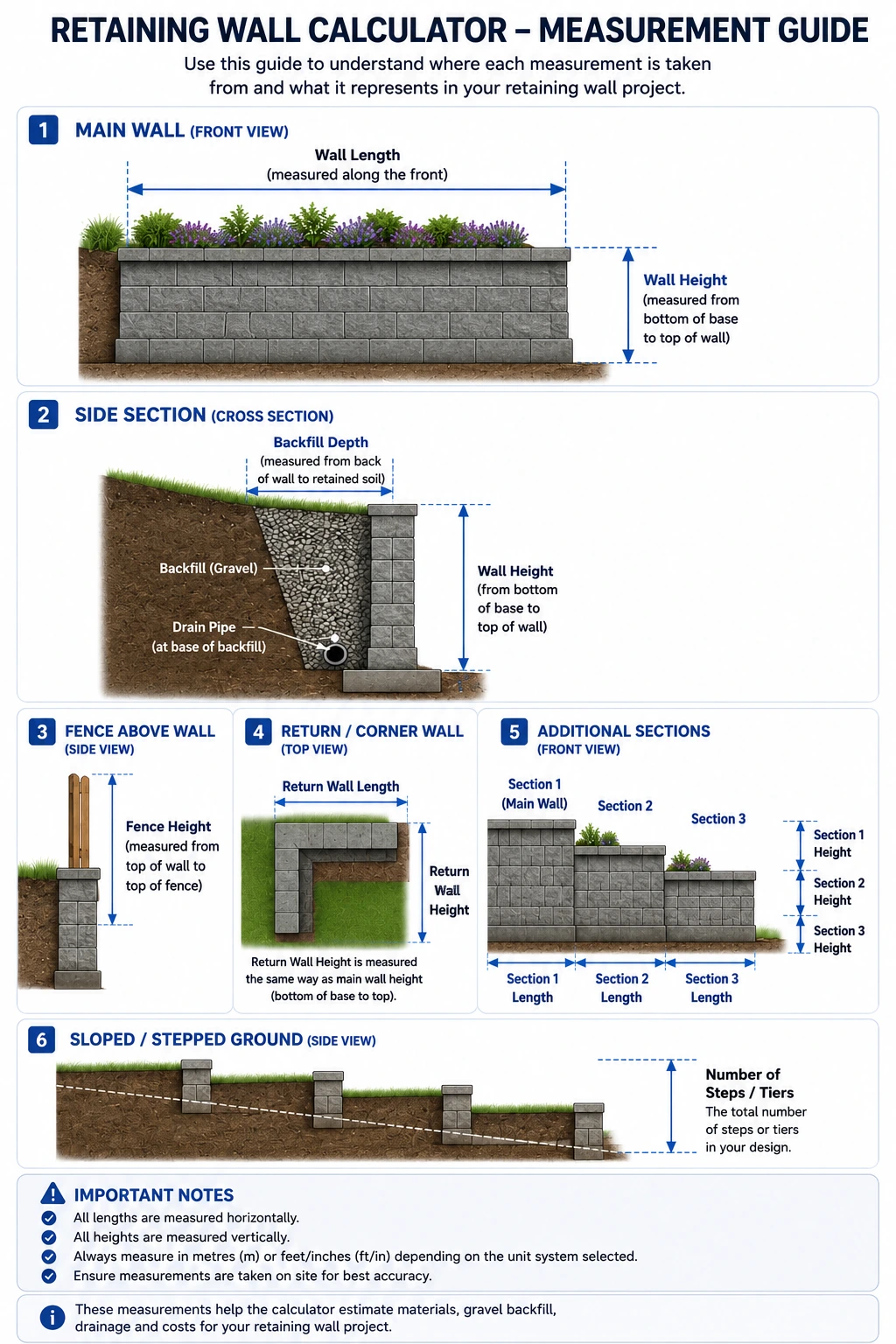
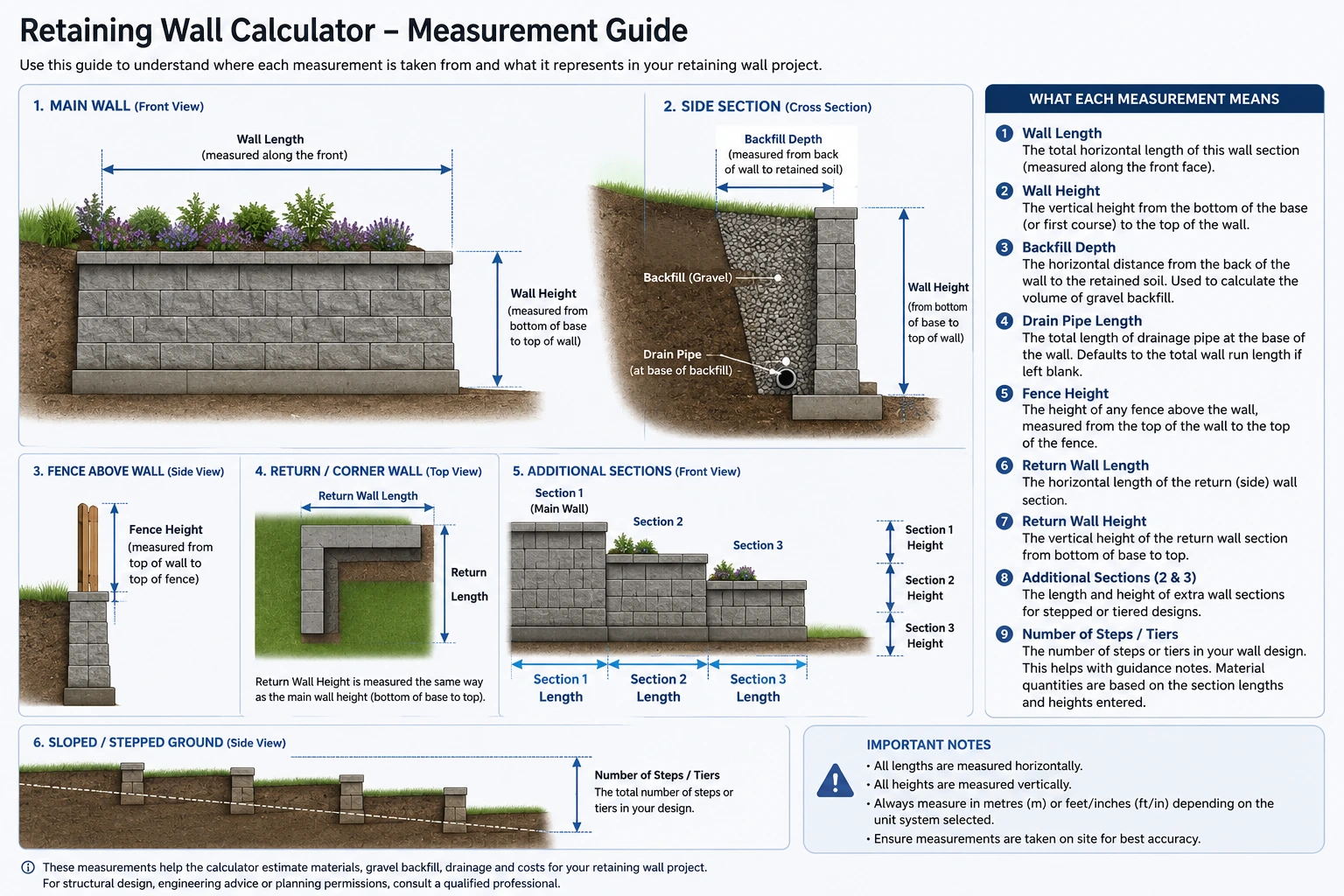
How to Use
Start with the main wall dimensions. In metric mode, enter wall length and height in metres. In imperial mode, enter feet and inches, and the calculator converts them into metres in the background.
Next, choose the wall type:
Concrete Block Wall
The calculator uses block length and block height to work out how many blocks are needed across each row and how many rows are needed vertically.
If you’re planning a concrete block wall, use our block calculator to calculate block quantities from your wall dimensions and block size. For a masonry retaining wall, you can also use our mortar calculator to estimate the mortar required.
Concrete Sleeper Wall
For walls built with slotted posts and precast sleepers. You can choose a sleeper length, and the calculator assumes a standard sleeper height.
Timber Sleeper Wall
For landscaping and lighter retaining walls. The material calculation works the same way as the concrete sleeper option, but the output label changes to timber sleepers.
Gabion Wall
Used when stone-filled baskets instead of a masonry wall is preferred. Choose the basket size, and the tool calculates how many baskets are needed across and up.
After that, set your wastage percentage. The default is 5%, which is sensible for many landscaping jobs where cuts, breakages and awkward ends create some waste.
In the optional cost section, enter a unit price for each block, sleeper or basket, plus a gravel cost per tonne. If you leave these blank, the calculator still gives quantities, but not a project total.
In Advanced mode, you can refine the estimate by adding:
- backfill depth behind the wall
- drain pipe length
- a fence above the wall
- a return wall
- sections 2 and 3 for stepped or tiered layouts
- number of steps or tiers for guidance notes
Results Explanation
Wall Area
The total face area of all entered wall sections in square metres.
Units Before Wastage
The base number of blocks, sleepers or baskets before extra allowance is added.
Backfill Volume
The volume of free-draining backfill behind the wall is based on wall area multiplied by backfill depth.
Gravel Required
The backfill volume was converted into tonnes using the calculator’s fixed gravel density assumption of 1.5 tonnes per cubic metre.
Wastage
Your chosen wastage percentage is shown both as a percentage and as extra units added on top of the base material count.
Drain Pipe Length
The drain run used for the estimate. If you leave this blank, the calculator defaults to the total wall length across all sections.
Fence Posts
Shown only when a fence type is selected. The calculator estimates post numbers using a default spacing assumption.
Total Estimated Cost
Shown only when you enter prices. This combines material cost and gravel cost.
The assumptions panel also updates with the selected material size, wastage level, footing guidance, drainage guidance and warning notes.
Once you know the required footing dimensions, use our concrete footing calculator to estimate the concrete required.
How the Maths Works
Step 1: Convert dimensions into metres
If the user chooses imperial units, the tool converts:
- feet to metres using 0.3048
- inches to metres using 0.0254
Metric entries are used directly.
Step 2: Build the wall geometry
The calculator always starts with the main wall, then adds any valid extra sections:
- main wall
- return wall
- section 2
- section 3
A section only counts if both its length and height are entered.
Step 3: Work out the wall area
For each section:
wall area = length × height
Then all section areas are added together.
Step 4: Calculate base material units
The maths changes slightly by wall type, but the idea is the same:
units per row = wall length ÷ unit length
number of rows = wall height ÷ unit height
Both values are rounded up, so you get whole units.
Then:
base units = units per row × number of rows
This is done separately for each section, then totalled.
Step 5: Add wastage
The tool calculates extra units as:
wastage units = base units × wastage %
That result is rounded up to a whole unit.
Then:
total units = base units + wastage units
Step 6: Calculate backfill volume
If the user leaves the backfill depth blank, the calculator uses a default of:
0.30 m
Then:
backfill volume = total wall area × backfill depth
More precisely, it sums:
section length × section height × backfill depth
for every section.
Step 7: Convert backfill to gravel tonnes
The tool uses a fixed density of:
1.5 tonnes per m³
So:
gravel required = backfill volume × 1.5
Step 8: Set drainage length
If a drain pipe length is entered, that value is used.
If it is left blank, the calculator defaults to:
total wall run length
Step 9: Estimate fence posts
When a fence is selected, the tool estimates posts using a default spacing of:
1.8 m
For each section:
posts = ceil(section length ÷ 1.8) + 1
It then adjusts overlaps between sections so corner joins do not double-count every shared post.
Step 10: Estimate total cost
If prices are entered:
material cost = total units × cost per unit
gravel cost = gravel tonnes × cost per tonne
total cost = material cost + gravel cost
If no prices are entered, the calculator still returns quantity results but leaves cost as guidance only.
Common Mistakes to Avoid
Entering only a length or only a height for extra sections. The calculator needs to include the section in totals.
Using the fence option without thinking about loading. A fence above a retaining wall can materially increase wind load and overturning risk, which is why the calculator shows extra warning text when fencing is included.
Ignoring drainage. Free-draining backfill and an outlet route matter because water pressure behind retaining walls is a common failure point.
Treating the result as an engineering design. The tool is for quantity planning and budgeting, not for structural sign-off.
Assuming all walls are covered by the same planning rules. Straight garden walls and fences may fall within common height limits, but retaining walls and other engineering works may still need separate checks with the local authority.
How Soil Type Affects a Retaining Wall
Not all retaining walls face the same pressure. The type of ground being held back can significantly affect drainage needs, footing design and how strong the wall should be.
Clay Soil
Clay expands when wet and can shrink when dry. It often holds water rather than draining freely, which can increase pressure behind the wall. Walls retaining clay usually need especially good drainage and may require a stronger design than the same wall built in free-draining ground.
Chalk Soil
Chalk is often more stable and naturally free-draining than clay, which can reduce water pressure build-up. However, chalk ground can vary, especially where it is fractured, sloped or mixed with topsoil, so footing conditions still need checking.
Sandy or Gravel Soil
These soils often drain well and place less hydrostatic pressure behind the wall when correctly compacted. However, loose material can move during excavation and may need careful preparation before building.
Made Ground or Filled Ground
Ground that has been previously filled or disturbed can be unpredictable. Old rubble, loose fill or mixed materials may settle over time, which can affect wall stability.
When to seek professional advice
If the retained ground is wet clay, sloping, recently filled, or unknown, take a more cautious approach and consider professional advice. Soil conditions are one reason two retaining walls of the same size may need very different construction methods.
FAQs
Do I need drainage behind a retaining wall?
In most cases, yes. Retaining walls hold back soil, and trapped water adds pressure behind the wall. Free-draining gravel, suitable drainage routes and outlets are commonly recommended.
How much gravel should I put behind a retaining wall?
This calculator works it out from the wall geometry and the backfill depth you enter. If you leave the backfill depth blank, it assumes 0.30 m. That gives you a planning estimate for free-draining backfill volume and converts it into tonnes.
Can I build a retaining wall myself?
A low, non-structural garden retaining wall may be suitable for DIY construction. Taller walls, greater retained loads, boundaries, fences and slopes can make the project considerably more complex. UK safety guidance warns that walls can fail dangerously, and retaining soil is one of the situations where standard height guidance for ordinary walls no longer tells the full story. If your wall doesn’t retain soil, our garden wall calculator is better suited to estimating a standard freestanding garden wall.
At what height should I get an engineer involved?
This calculator itself warns that walls over 1.0 m may need structural design and that taller walls, combined wall-and-fence heights, or more complex layouts are more likely to need engineering review. The real trigger is not height alone. Soil, surcharge, drainage, footing conditions and nearby structures all matter.
Do I need planning permission for a retaining wall in the UK?
You can often build ordinary garden walls or fences without planning permission if they stay within common height limits, typically 1 metre next to a highway used by vehicles or 2 metres elsewhere in England. But retaining walls can count as engineering works, so those simple limits do not always settle the question. Some councils explicitly warn that retaining walls and embankments may still need permission.
What wall types does this calculator support?
It supports concrete block walls, concrete sleeper walls, timber sleeper walls and gabion walls.
How does the calculator work out block, sleeper or basket quantities?
It divides each wall section by the selected material size, rounds up to whole units across and up, then adds all sections together before applying wastage.
Does it include labour or concrete footing cost?
No. It only estimates material units, gravel, drainage length, optional fence posts and the optional price fields you enter. Labour, excavation, concrete, reinforcement, geogrid, disposal and delivery are not separately priced.
Related Calculators:
Disclaimer
This calculator is for planning, budgeting and material estimating only. It is not a structural design tool.
Retaining walls are different from ordinary garden walls because they resist soil pressure and often water pressure, too. UK guidance on walls stresses the safety risks of unstable masonry, and Planning Portal guidance specifically says ordinary wall thickness-height advice may not apply where a wall is retaining soil.
Before building, check:
- whether the wall may count as an engineering operation requiring planning input
- whether the site is near a highway, boundary, listed building or constrained area
- whether drainage outlets are available
- whether a fence above the wall increases the loading
- whether a structural engineer or a competent retaining wall contractor should review the design
For anything tall, heavily loaded, stepped, near neighbouring land, or carrying a fence, get professional advice before construction.