Screed Calculator
Estimate floor screed volume, bag quantities and material cost from floor area, screed depth and wastage.
- Area method: Length × Width
- Screed type: Traditional sand/cement screed
- Wastage allowance: 10%
- Uneven base method: Use the screed depth only
- Effective depth used: —
- Bag yield: 25 kg bag ≈ 0.0125 m³
- Bag counts are rounded up to the next whole bag.
- Bag yields vary by product, moisture content and manufacturer. Always check the supplier’s stated mixed yield before ordering.
- Results are for planning and estimation purposes only — not a structural, installation or manufacturer specification.
Use this Screed Calculator to estimate how much screed you need for a floor, including screed volume, bag quantities, approximate material weight and estimated costs. The calculator supports both metric and imperial measurements, traditional sand and cement screed, liquid screed and bagged screed mixes. It also includes uneven base allowances, wastage settings and optional cost comparisons.
PRO TIP: For older concrete slabs or uneven substrates, use the measured-depth option rather than a flat percentage allowance. Taking several laser level readings usually gives a far more realistic screed order quantity.
How to Use this Screed Calculator
Choose Your Measurement Method
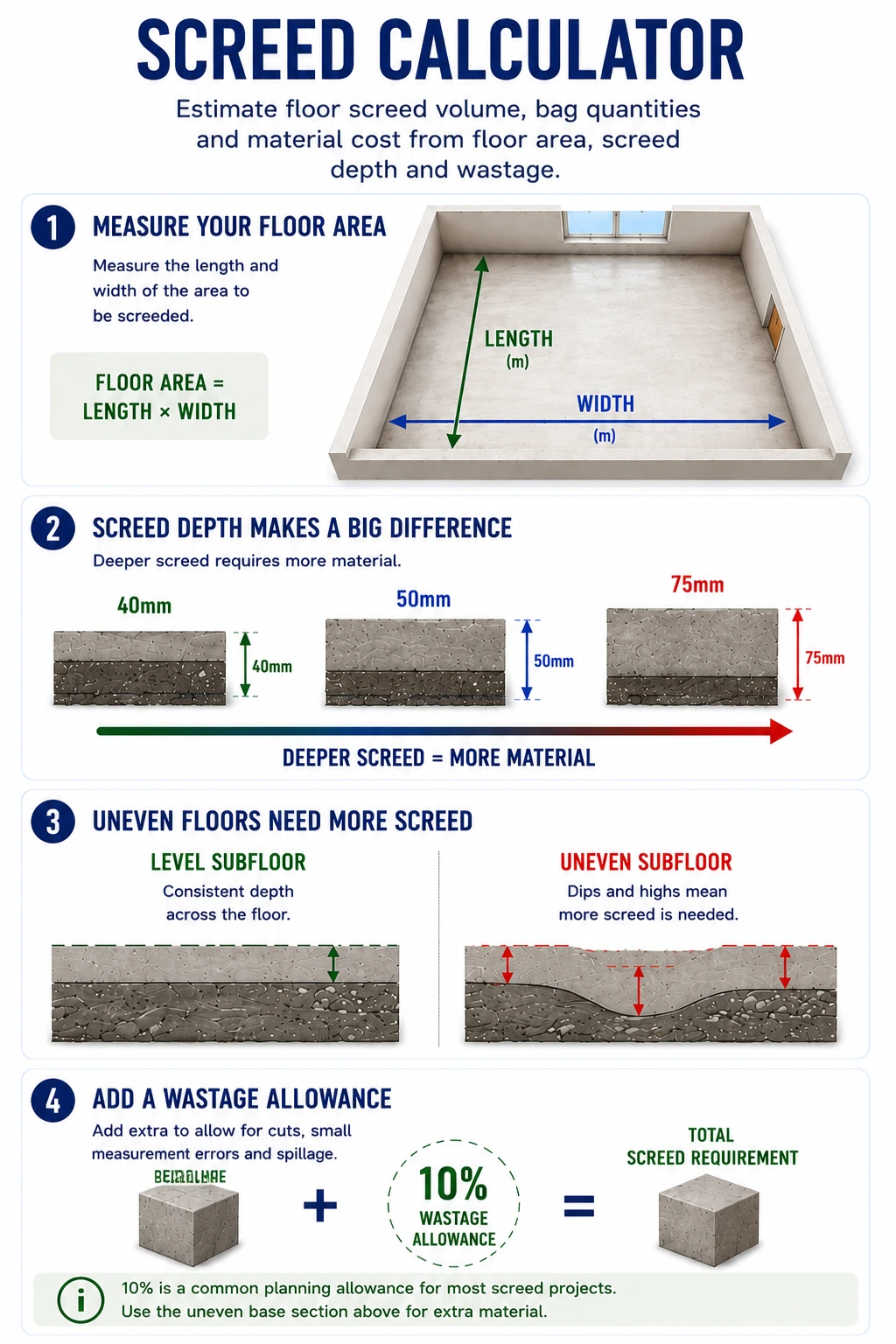
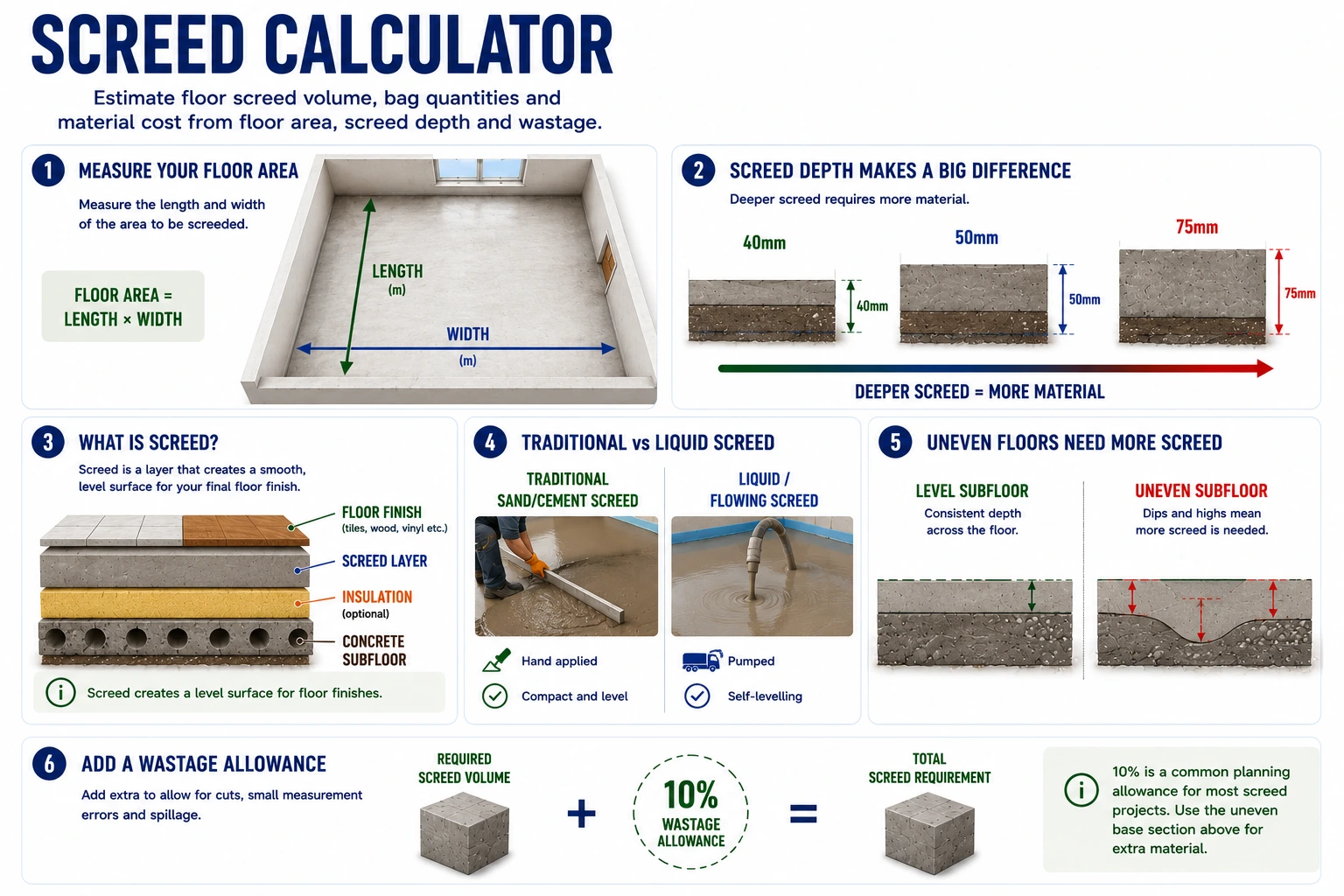
The calculator lets users either enter floor length and width or a known total floor area.
Enter Screed Depth
Users can enter A single screed depth or a minimum and maximum measured depth for uneven floors
The measured-depth option averages the low and high readings to estimate a realistic working depth.
Select Screed Type
Supported screed types:
- Traditional sand/cement screed
- Liquid / flowing screed
- Bagged screed mix
Liquid screed calculations focus on volume ordering, while bagged screed estimates use bag yield values.
Add Wastage
The default wastage allowance is 10%, which helps cover minor spills, small measuring errors, surface variations or mixing losses.
Users can adjust wastage from 0–30%.
Allow for Uneven Floors
The calculator includes preset uneven base allowances, custom allowance percentages or measured min/max depth averaging
Add Costs (Optional)
Users can compare:
- Cost per bag
- Bulk screed cost per m³ or yd³
If both prices are entered, the results compare bagged and bulk screed costs.
Results Explanation
The calculator provides:
- Total screed volume required
- Approximate number of bags needed
- Estimated material weight
- Estimated bag material cost
- Estimated bulk screed cost
- Effective screed depth used
- Final volume including wastage and allowances
Bag quantities are always rounded up to the next whole bag to help avoid under-ordering.
For liquid screed, the calculator switches to volume-based ordering because flowing screed is typically supplied in cubic metres rather than bags.
How the Maths Works
The calculator first works out the floor area.
For rectangular rooms:
Floor Area=Length×Width
It then converts screed depth into metres and calculates the base screed volume:
Base Volume=Floor Area×Depth
If an uneven base allowance is used, extra volume is added before wastage:
Adjusted Volume=Base Volume×(1+100Allowance %)
Wastage is then applied:
Final Volume=Adjusted Volume×(1+100Wastage %)
For bagged screed, the calculator divides the final volume by the selected bag yield and rounds up:
Bags Required=⌈Bag YieldFinal Volume⌉
Measured-depth mode uses the average of the minimum and maximum depth readings before calculating volume.
Common Mistakes to Avoid
- Forgetting to include wastage
- Measuring room size before insulation or edging strips are fitted.
- Using nominal bag coverage instead of the manufacturer’s mixed yield
- Ordering exactly the calculated amount with no contingency
- Ignoring low spots in older floors
- Mixing up millimetres and inches
- Assuming that flowing screed and traditional screed use the same coverage rates
faqs
How thick should floor screed be?
Typical bonded screed is often around 25–40mm, while floating screed over insulation is usually thicker. Always follow the screed manufacturer’s guidance and any structural specifications for your project.
How much screed do I need for underfloor heating?
Underfloor heating systems normally require enough screed to fully cover the heating pipes while maintaining the manufacturer’s minimum depth recommendation. Liquid screeds are commonly used because they flow around pipes more evenly.
Should I order extra screed?
Yes. Most installers allow for wastage, uneven floors and minor site losses. A 5–10% allowance is common for straightforward projects, but rough or uneven floors may need more.
Is liquid screed cheaper than traditional screed?
Material prices vary, but liquid screed can reduce labour time and may provide better coverage around underfloor heating. Traditional sand/cement screed can sometimes be cheaper for small areas.
How long does screed take to dry?
Drying time depends on screed type, thickness, temperature and ventilation. Traditional screed often dries more slowly than flowing screed products. Always follow the supplier’s drying guidance before laying floor finishes.
Can I screed directly onto concrete?
Yes, in many cases. However, the concrete base must usually be clean, sound and prepared correctly. Some floors may also require primers, membranes or bonding agents. For thinner levelling applications rather than a full screed layer, use our self-levelling compound calculator to estimate the material required. If you’re also calculating the concrete slab beneath the screed, use our concrete calculator to estimate the concrete volume required.
How are bag quantities calculated?
The calculator divides the required screed volume by the selected bag yield and rounds the result up to the next full bag.
What does the uneven base allowance do?
It adds extra screed volume before wastage is applied to help account for dips, rough slabs and floor level variations.
related calculators
Disclaimer
Results are estimates only for planning and material ordering. Actual screed yield varies by product, water content and mixing consistency. Always check manufacturer coverage data before purchase. Structural floors and load-bearing installations may require professional specification. Drying times and thickness requirements vary between screed systems. For underfloor heating systems, follow the heating and screed manufacturer’s installation guidance.