Ballast Calculator
Calculate how much ballast and cement you need to mix concrete, or work out the cement required for a known amount of ballast.
Show calculation
- Mix: 1 cement : 5 ballast
- Ordering allowance: 10%
- Ballast bulk bag weight: 800 kg
- Cement bag weight: 25 kg
- Ballast and cement package quantities are rounded up to whole bags.
- Results are planning and material estimates only — not a structural specification.
Important calculation assumptions
- Project dimensions are treated as finished concrete dimensions.
- Concrete depth must come from the project specification or appropriate construction guidance; the calculator does not design the required structural depth.
- Mix selections are planning ratios by loose volume and do not guarantee a particular concrete strength class.
- Follow the cement manufacturer’s or project specification where it gives a different mix or material requirement.
- Ordering allowance is intended for dimensional variation, spillage and ordering contingency.
- Advanced additional areas are calculated individually at their own depths before being combined.
- Bulk bag weights are nominal and can vary by supplier and moisture content. Use the supplier’s stated weight where available.
- For Cement for Known Ballast, the estimated cost is for cement only; the known ballast is treated as already available or separately planned.
- Cost estimates exclude delivery, labour and other charges.
Work out how much ballast and cement you’ll need before ordering materials with this ballast calculator. Enter the size and depth of the concrete pour, and the calculator will estimate the ballast and cement required, including the number of bulk bags and cement bags to buy.
Already know how much ballast you’re getting? Switch to Cement for Known Ballast to work backwards and calculate the cement instead.
PRO TIP: Check your supplier’s stated bulk-bag weight before ordering. The calculator uses 800 kg per bag by default, but bag weights can vary between suppliers. If yours is different, enter the correct weight in Advanced mode. You can also change the default 25 kg cement bag size there.
How to Use this Ballast Calculator
Start with the dimensions of the concrete itself — not the overall excavation. Enter the length and width, or use Known Area if you’ve already worked out the square metres.
Next, enter the finished concrete depth. We’ve included common depths as shortcuts, but these aren’t recommendations. If your plans call for 120 mm, choose Custom Depth and enter 120 mm.
If you’re pouring areas at different depths, switch to Advanced and add them separately. There’s no need to work out an average depth first.
What Your Results Mean
The headline figures are the quantities you’d actually order: whole bulk bags of ballast and whole bags of cement.
These are rounded up, not to the nearest bag. So if the calculation comes to 2.2 bulk bags, the result will show 3. The surplus figure tells you roughly how much ballast that leaves above the calculated requirement.
The weights and concrete volume underneath are useful for checking the calculation, but don’t try to buy exactly those weights unless your supplier sells loose material by weight.
How the Maths Works
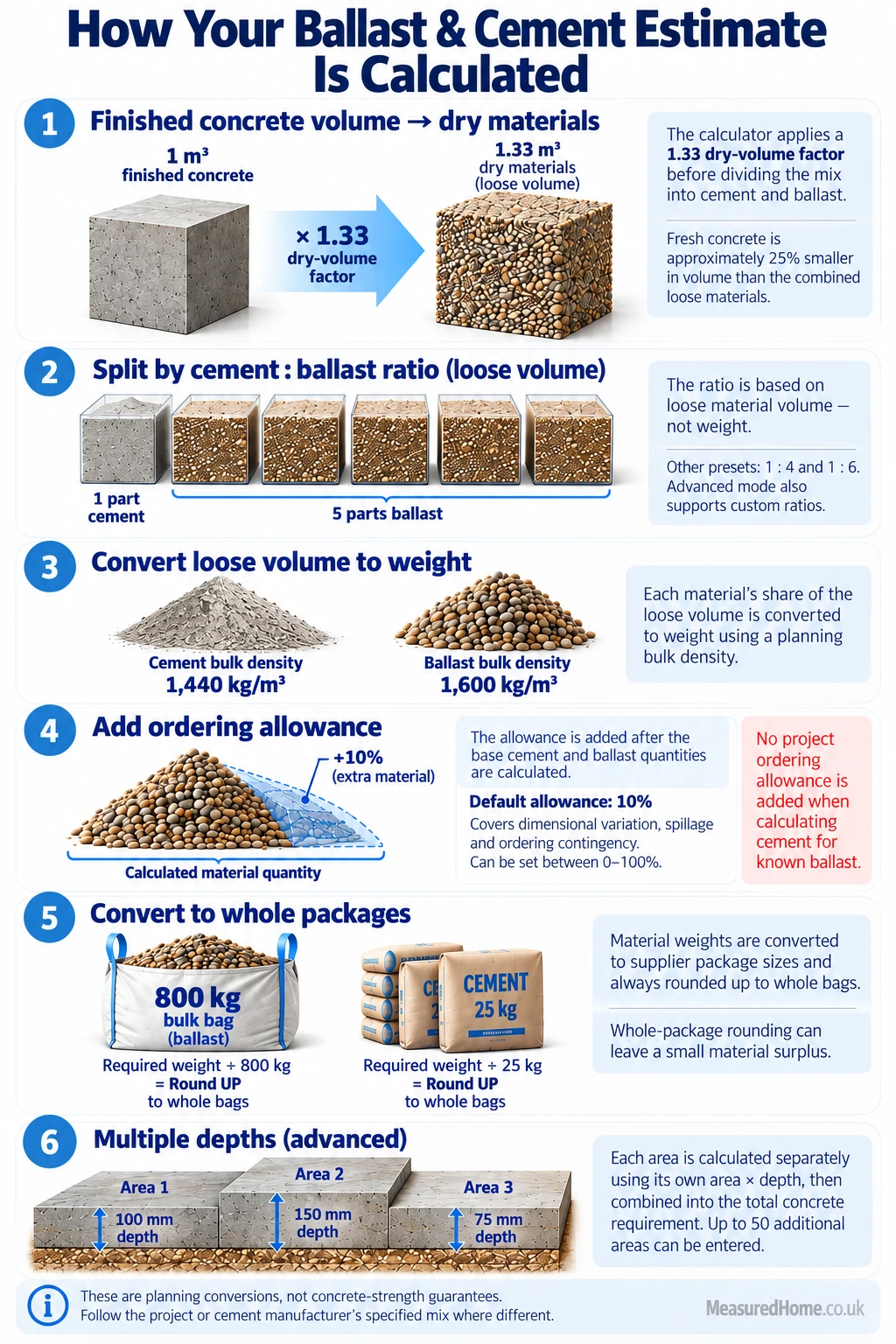
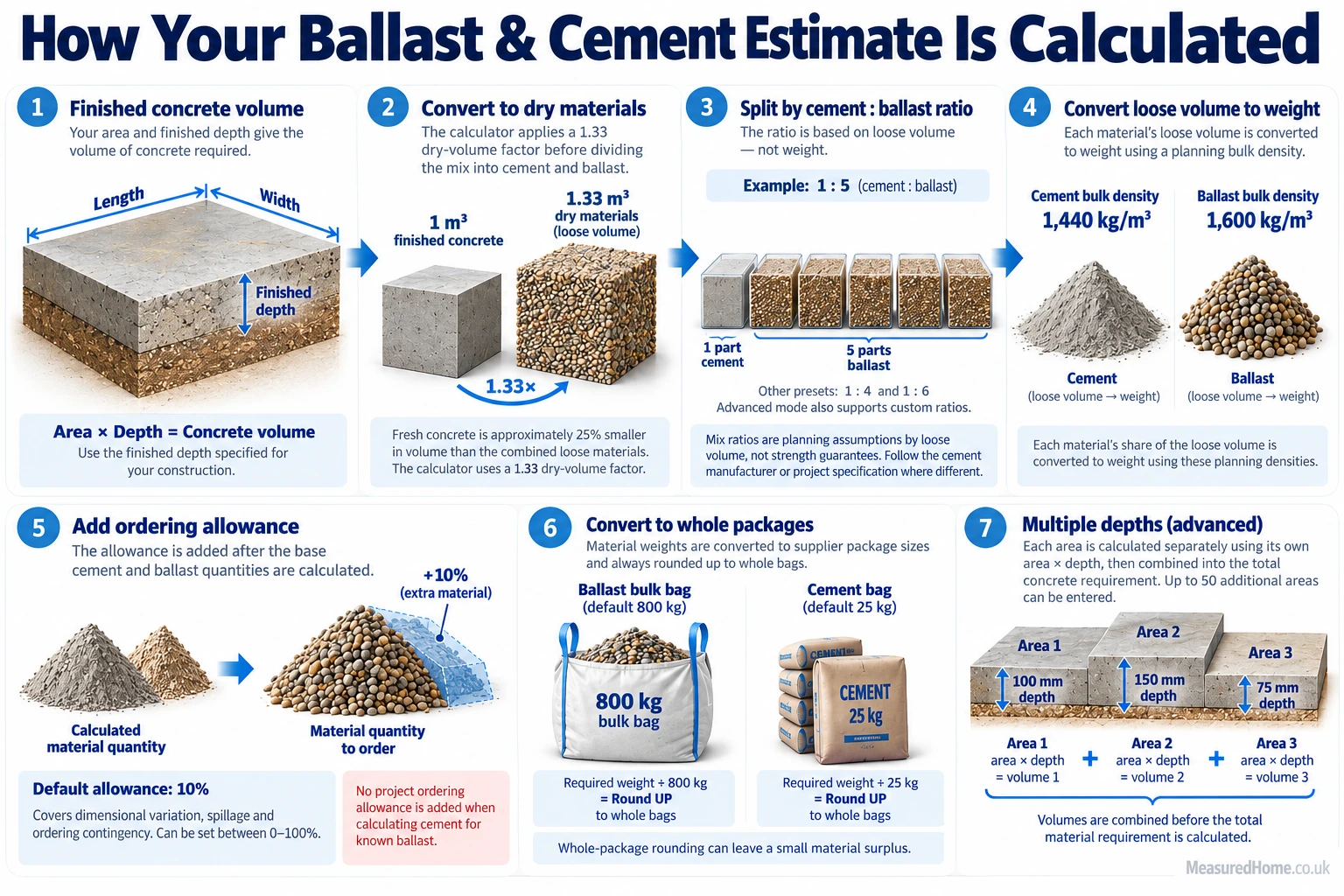
For a rectangular project, area is length × width. If a known area is entered, it is converted to square metres. The finished concrete volume is then calculated.
Area × depth = concrete volume
The loose dry ingredients take up more volume than the finished concrete, so the calculator multiplies the concrete volume by 1.33 to estimate the dry material volume.
That volume is then divided according to your chosen mix. With the default 1:5 mix, there are six parts in total: one cement and five ballast.
To convert those volumes into weights, the calculator assumes:
- cement: 1,440 kg/m³
- ballast: 1,600 kg/m³
Your chosen allowance is added afterwards, then the result is rounded up to complete bulk bags and cement bags.
Common Mistakes to Avoid
- Measure the concrete, not the excavation. If you’ve dug 200 mm down but 100 mm of that is hardcore, don’t enter 200 mm as the concrete depth.
- Don’t treat 1:5 as a strength specification. It’s the calculator’s default planning mix, not a guarantee of a particular concrete grade.
- Don’t average different depths. If different parts of the pour have different depths, add them separately in Advanced mode rather than trying to invent one average depth.
FAQs
How much ballast do I need for concrete?
It depends on the size and depth of the pour and the mix you’re using. Enter those figures above and you’ll get both the calculated ballast weight and the number of bulk bags to order.
How many bags of cement do I need per bulk bag of ballast?
With the calculator’s defaults, an 800 kg bulk bag, 1:5 mix and 25 kg cement bags, the result is 6 bags of cement. Change the bulk-bag weight or mix ratio and the amount will change, so use Cement for Known Ballast if your figures are different.
What cement-to-ballast ratio should I use?
Use the mix specified for the job or recommended by the cement manufacturer. The calculator includes 1:4, 1:5 and 1:6 as convenient planning options, with 1:5 selected by default. You can also enter your own ratio in Advanced mode.
Should I add extra ballast and cement for wastage?
A little extra can cover small measuring differences, spillage and other losses on site. The calculator calls this the ordering allowance and starts at 10%. You can change it or set it to 0% if you don’t want any extra added.
Why has the calculator rounded my ballast up?
Ballast is shown as whole bulk bags because that’s normally how you’ll order it. If the calculation needs 2.2 bags, for example, the buying quantity becomes 3. The results also show the estimated surplus.
Does the 10% allowance apply to both ballast and cement?
Yes. For a concrete project, the calculator applies your chosen allowance to both the ballast and cement requirements before working out the number of bags to buy. The Cement for Known Ballast calculation works differently and doesn’t add this project allowance.
related calculators
Concrete Mix Calculator
Concrete Calculator
MOT Type 1 Calculator
Disclaimer
This calculator is for estimating material quantities, not designing concrete. It doesn’t determine slab thickness, concrete strength or structural suitability. Use the dimensions and mix specified for your job and follow the cement manufacturer’s instructions where they differ from the calculator assumptions.
Bulk-bag weights vary between suppliers, so check the stated bag weight before ordering. Results are rounded up to whole bags and may therefore leave surplus material.
Cost estimates cover only the material prices you enter. Delivery, labour, plant and disposal aren’t included.