Kerb & Edging Concrete Calculator
Estimate concrete for the bed and supporting haunch, including waste, bags and optional material cost.
- Waste allowance: 10%
- Haunch shape: triangular section on both sides.
- Whole bags are rounded up using 12.5 L mixed yield per bag.
Use this kerb edging concrete calculator to estimate how much concrete you need for a bedding layer and optional side haunches. It is designed for garden edging, path edging, driveway kerbs and similar linear installations where concrete is placed beneath and beside each unit.
Enter one or more run lengths, then add the bed width and depth. You can include a triangular haunch on one side, both sides or neither side. The calculator adds your chosen wastage allowance and shows the final concrete volume, a run-by-run breakdown and an optional cost estimate.
You can work in metric units using metres and millimetres, or switch to imperial units using feet and inches. Results are displayed in cubic metres and litres for metric calculations, or cubic yards and cubic feet for imperial calculations.
PRO TIP: Measure the actual trench and proposed concrete profile rather than relying only on nominal kerb dimensions. Ground conditions, excavation tolerances and uneven sub-bases can all increase the amount of concrete used. For long runs, divide the work into logical sections and enter each section separately so that the run breakdown can help with batching and sequencing.
How to use this kerb & Edging concrete calculator
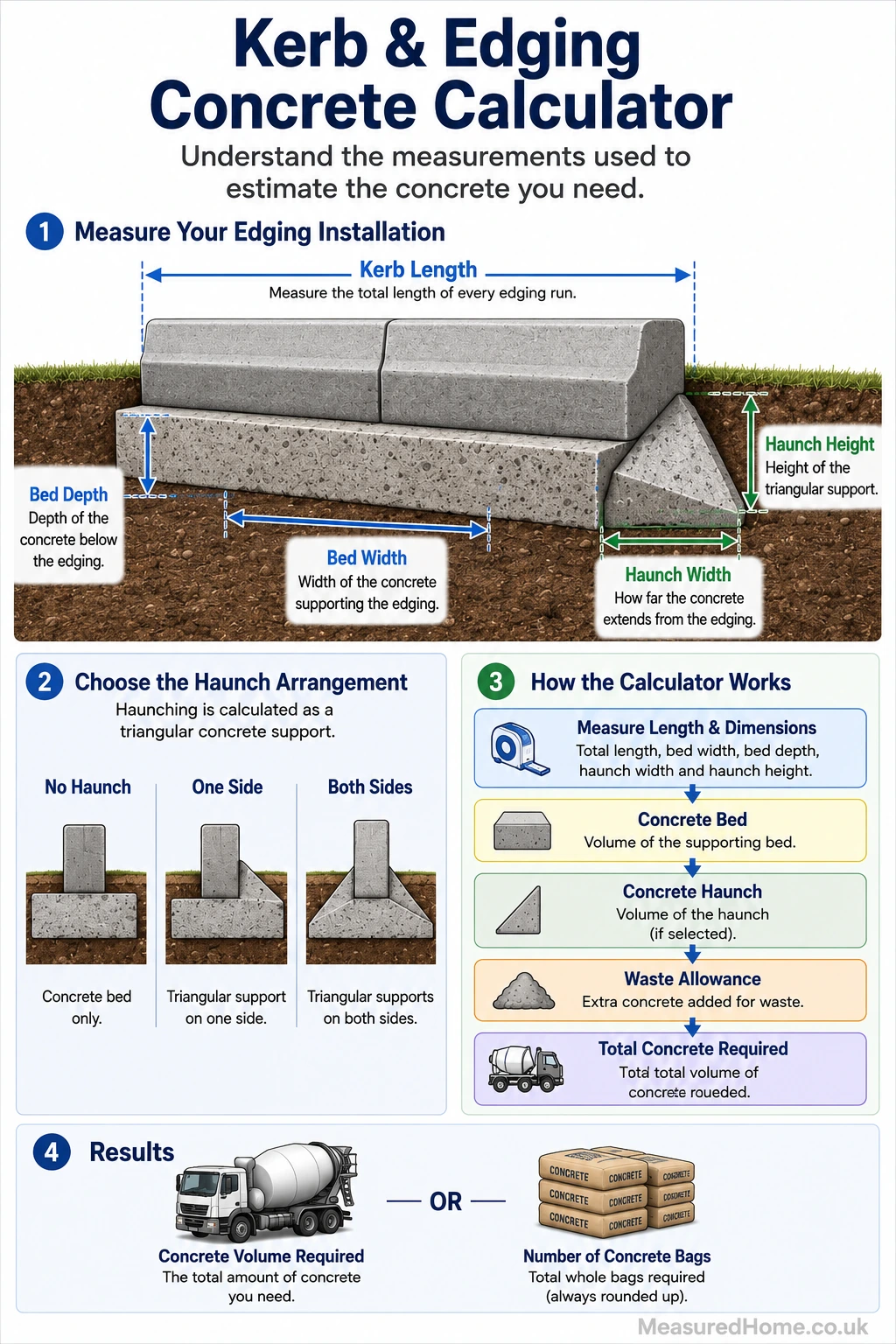
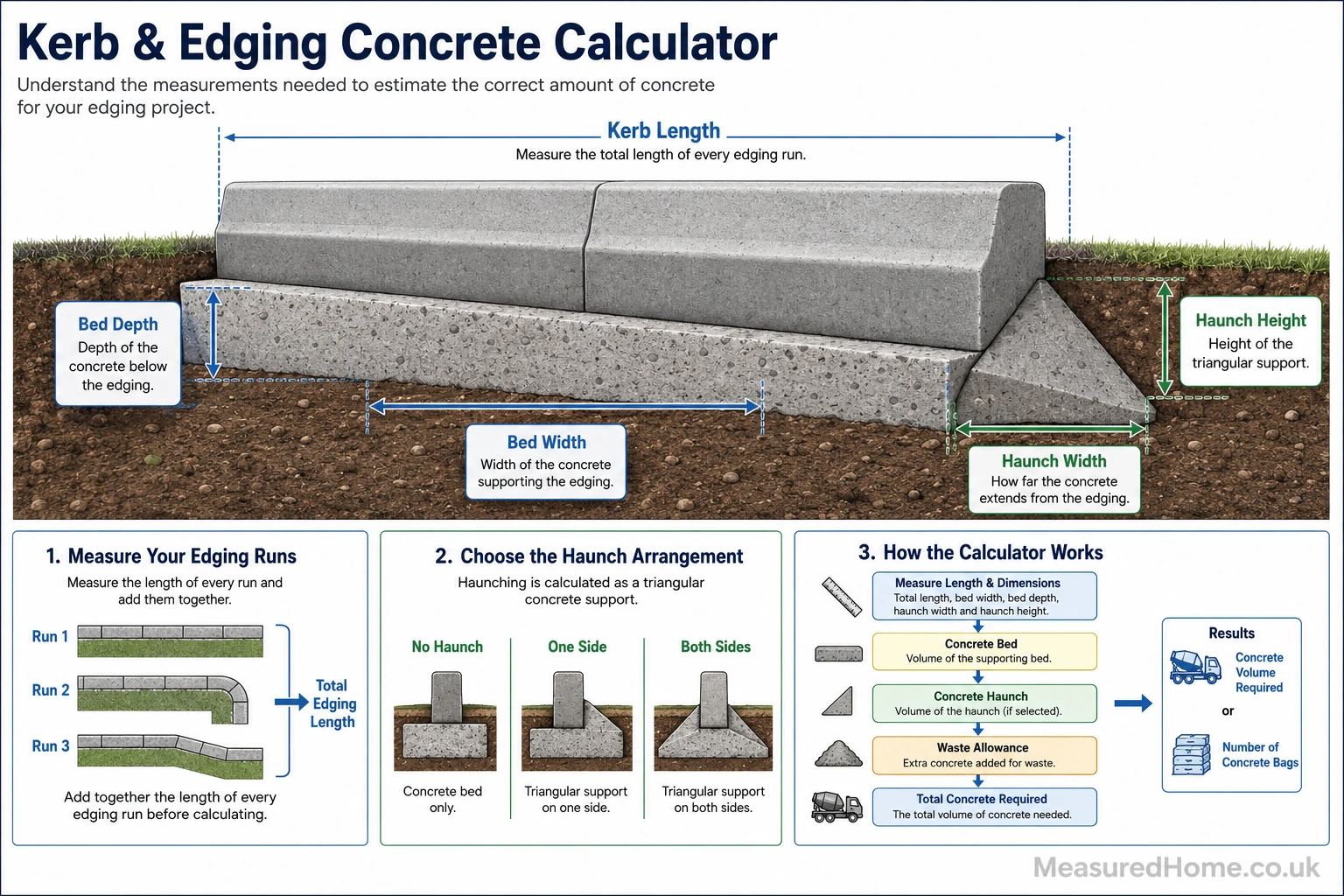
Measure the total length of kerb or edging being installed. Separate sections can be entered as individual runs, which is useful for paths, borders or driveway edges with several sides.
Next, measure the width and depth of the concrete bed beneath the edging. These should be the dimensions of the concrete itself rather than the kerb or edging unit.
If the installation includes side haunching, select one or both sides and enter the width and height of the haunch. Each haunch is calculated as a triangular section alongside the concrete bed.
Choose whether you’re using ready-mix or bagged concrete. For bags, use the manufacturer’s stated yield where possible. You can then add a wastage allowance and optional concrete or bag price to estimate the purchasing cost.
results explanation
| Total length | The combined length of every run entered. This is the length used for both the bed and haunch calculations. |
| Bed volume | The volume of the rectangular bedding layer beneath the full kerb or edging length. |
| Haunch volume | The combined volume of all selected triangular side haunches. This is zero when no haunching is selected. |
| Net volume | The bed volume plus the haunch volume before wastage. |
| Waste volume | The extra amount added using your chosen wastage percentage. |
| Final volume | The total concrete requirement after wastage. In metric mode this is shown in cubic metres and litres. In imperial mode it is shown in cubic yards and cubic feet. |
| Whole bags | For bagged concrete, the calculator divides the final litres by the selected bag yield and rounds up to the next whole bag. This avoids showing an impractical fraction of a bag. |
| Estimated cost | For ready-mix, cost is the final volume multiplied by the entered price per cubic metre or cubic yard. For bagged concrete, cost is the rounded-up whole-bag quantity multiplied by the cost per bag. |
| Run breakdown | Each run is listed separately with its combined bed and haunch volume. This is useful when planning phased work or checking how much concrete is needed for different areas. |
How the Maths Works
The calculator converts every measurement to metres internally so that all concrete volumes can be calculated in cubic metres. Imperial measurements are converted using 1 foot = 0.3048 metres and 1 inch = 25.4 millimetres.
Concrete bed
The bedding layer is treated as a rectangular prism:
Bed volume = total length × bed width × bed depth
Concrete haunch
Each side haunch is treated as a triangular prism. The triangular cross-sectional area is half the haunch width multiplied by the haunch height:
Haunch volume = total length × number of sides × 0.5 × haunch width × haunch height
Final concrete volume
The bed and haunch volumes are added to give the net volume. Wastage is then added:
Final volume = net volume × (1 + wastage percentage ÷ 100)
Bag quantity
The final cubic metres are converted to litres using 1 cubic metre = 1,000 litres. The required number of bags is then rounded up:
Whole bags = final litres ÷ litres yielded per bag, rounded up
Displayed imperial volumes
For imperial results, cubic metres are converted using approximately 1 cubic metre = 1.30795 cubic yards or 35.3147 cubic feet.
Common Mistakes to Avoid
- Entering the kerb width instead of the full concrete bed width.
- Forgetting that a haunch on both sides doubles the triangular haunch volume.
- Mixing metres with millimetres, or feet with inches, in the wrong fields.
- Using the bag weight as the bag yield. The calculator needs litres of mixed concrete produced per bag.
- Leaving out bends, returns, end sections or short connecting runs.
- Using no wastage allowance where the trench is uneven, or measurements are approximate.
- Assuming the calculated ready-mix volume will match a supplier’s minimum order or delivery policy.
- Rounding bag quantities down instead of using the whole-bag result.
faqs
How much concrete do I need under kerb edging?
The amount depends on the total run length and the width and depth of the bedding layer. It increases further when one or two side haunches are added. Enter the intended concrete dimensions into the calculator to estimate the volume.
Should kerbs and edging be haunched on one side or both sides?
That depends on the edging type, loading, ground conditions and installation detail. Some light garden edging may need less restraint than driveway or traffic-adjacent kerbs. Follow the product or project specification and seek professional advice where the edging is structural or load-bearing. If the kerbs form part of a new driveway project, use our concrete driveway cost calculator to estimate the concrete, sub-base and material costs for the driveway itself.
What wastage allowance should I use?
The calculator defaults to 10%, which is a practical starting point for many small jobs. A more regular excavation may need less, while irregular trenches, spillages, hand mixing or uncertain measurements may justify more. The calculator accepts 0% to 50%.
Is bagged concrete or ready-mix better for kerb edging?
Bagged concrete can suit small or staged jobs because it is easy to buy in whole bags. Ready-mix can be more practical for larger continuous runs, but delivery access, minimum order quantities and placing time should be checked with the supplier. If you’re mixing the concrete yourself rather than using premixed bags or ready-mix, use our concrete mix calculator to calculate the cement, sand, aggregate and water required.
How do I estimate the cost of ready-mix concrete?
Enter the supplier price per cubic metre when using metric units, or per cubic yard when using imperial units. The calculator multiplies that rate by the final volume after wastage. Delivery, part-load, waiting-time, pump and access charges are not included.
How are bag quantities calculated?
The final concrete volume is converted to litres and divided by the stated litres yielded per bag. The result is rounded up to a whole bag. Presets use 10 litres for 20 kg bags, 12.5 litres for 25 kg bags and 20 litres for 40 kg bags, but you can enter a custom yield from the manufacturer’s information. For a more detailed bagged-concrete estimate including supplied volume, total weight and leftover concrete, use our concrete bags calculator.
Does this calculator confirm the correct foundation or kerb specification?
No. It estimates concrete quantity from the dimensions you provide. It does not design the installation or confirm suitability for loading, drainage, ground conditions, product requirements or regulatory compliance.
related calculators
Concrete Patio Calculator
Garden Wall Calculator
disclaimer
This calculator is an estimating tool based on the measurements and options entered. Actual concrete use may vary because of excavation tolerances, uneven ground, compaction, settlement, spillages, batching variation and the final shape of the bed or haunch.
The calculator presets use assumed yields of 10 litres for a 20 kg bag, 12.5 litres for a 25 kg bag and 20 litres for a 40 kg bag. Manufacturer yields can differ, so check the packaging or technical data and use the custom yield option where necessary.
Cost estimates cover only the entered concrete rate or bag price. They do not include delivery charges, minimum-load charges, part-load fees, pumps, labour, plant, reinforcement, sub-base materials, excavation, disposal, formwork or VAT unless those costs are already included in the price entered.
The calculator does not provide structural design advice. Installation details should follow the kerb or edging manufacturer’s instructions and the project specification. Work near highways, drainage, services, retaining structures or load-bearing areas may require a competent contractor, engineer, utility checks, permissions or professional sign-off.
Use appropriate personal protective equipment when handling cement and concrete. Avoid skin and eye contact, control dust when opening or mixing bags, and follow the product safety information. Fresh concrete and cement-based materials can cause serious burns.