Low Carbon Concrete Calculator
Estimate A1–A3 (cradle-to-gate) embodied carbon for a concrete project and compare lower-carbon concrete with a standard reference mix.
- Concrete type: Standard Concrete
- Wastage allowance: 5%
- A1–A3 carbon factor: — kg CO₂e/m³
- Standard A1–A3 reference factor: — kg CO₂e/m³
- Results estimate A1–A3 (cradle-to-gate) product-stage embodied carbon from concrete volume and the selected carbon factor.
- Transport to site (A4), construction/site activities (A5), use-stage impacts and end-of-life impacts are outside this calculator’s intended boundary.
- Actual A1–A3 impacts vary by mix design, strength class, binder content, supplier and production site.
- Preset carbon factors are illustrative benchmark starting points, not universal values for every concrete of that type.
- Use supplier-specific EPD or project data where available, ensuring the factor uses an A1–A3 boundary.
Use this low-carbon concrete calculator to estimate the embodied carbon of the concrete in a project. Enter the concrete volume, add an allowance for wastage and choose a concrete type or supply your own verified carbon factor. The calculator can also compare the selected mix with a standard reference mix to show the estimated carbon saving.
You can work in cubic metres or cubic yards and add a price per unit volume for a simple material cost estimate. The results are intended for early-stage option appraisal and budgeting. For specifications, procurement or formal carbon reporting, use project-specific information from the concrete supplier, an Environmental Product Declaration (EPD) or another suitable verified source.
PRO TIP: Ask suppliers for mix-specific EPD data and compare products on a like-for-like basis. Check that the declared unit, assessment boundary, strength class, exposure class, curing requirements and transport assumptions are suitable for your project. A mix with a lower headline carbon factor is only a valid alternative when it also meets the structural, durability, programme and placement requirements.
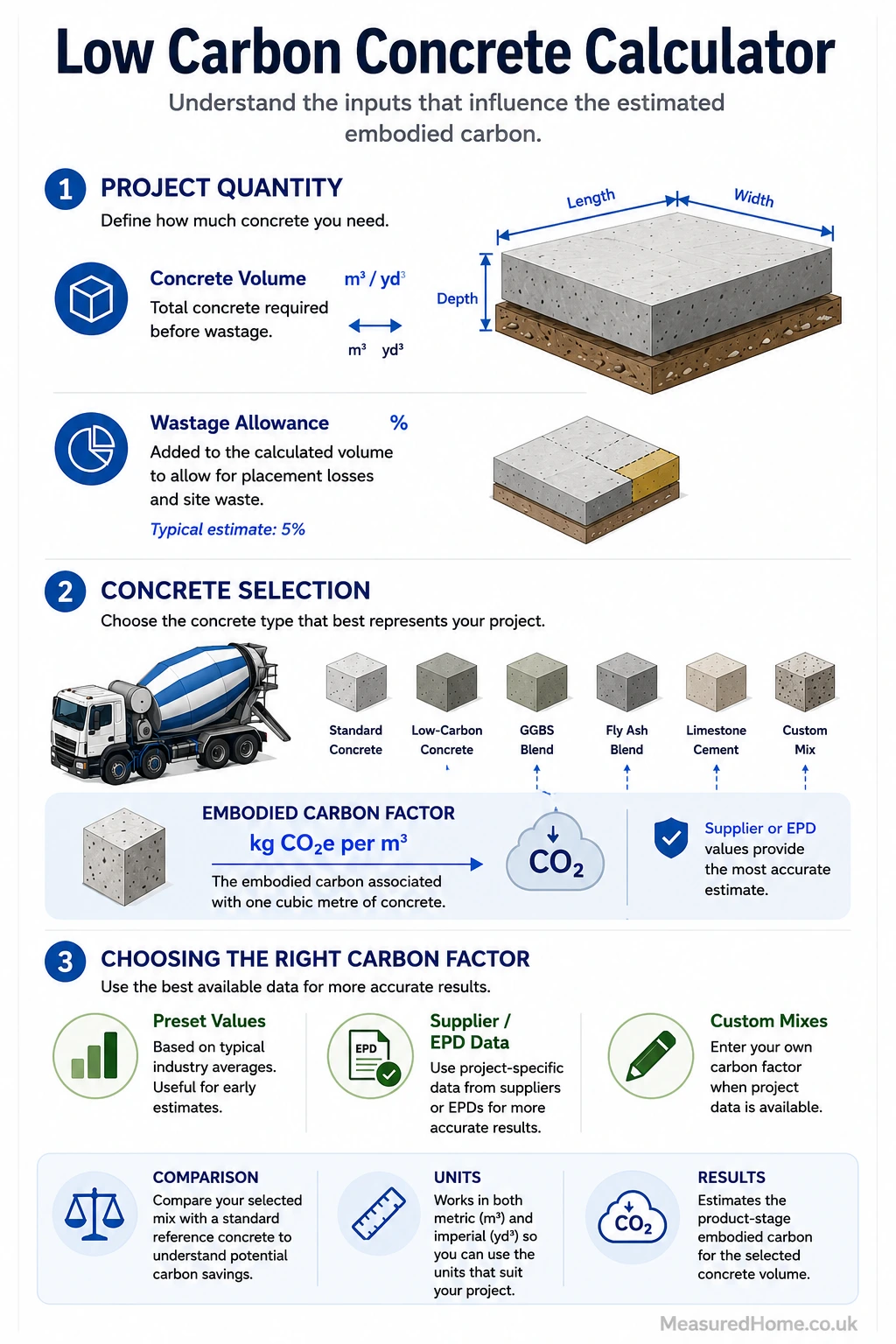
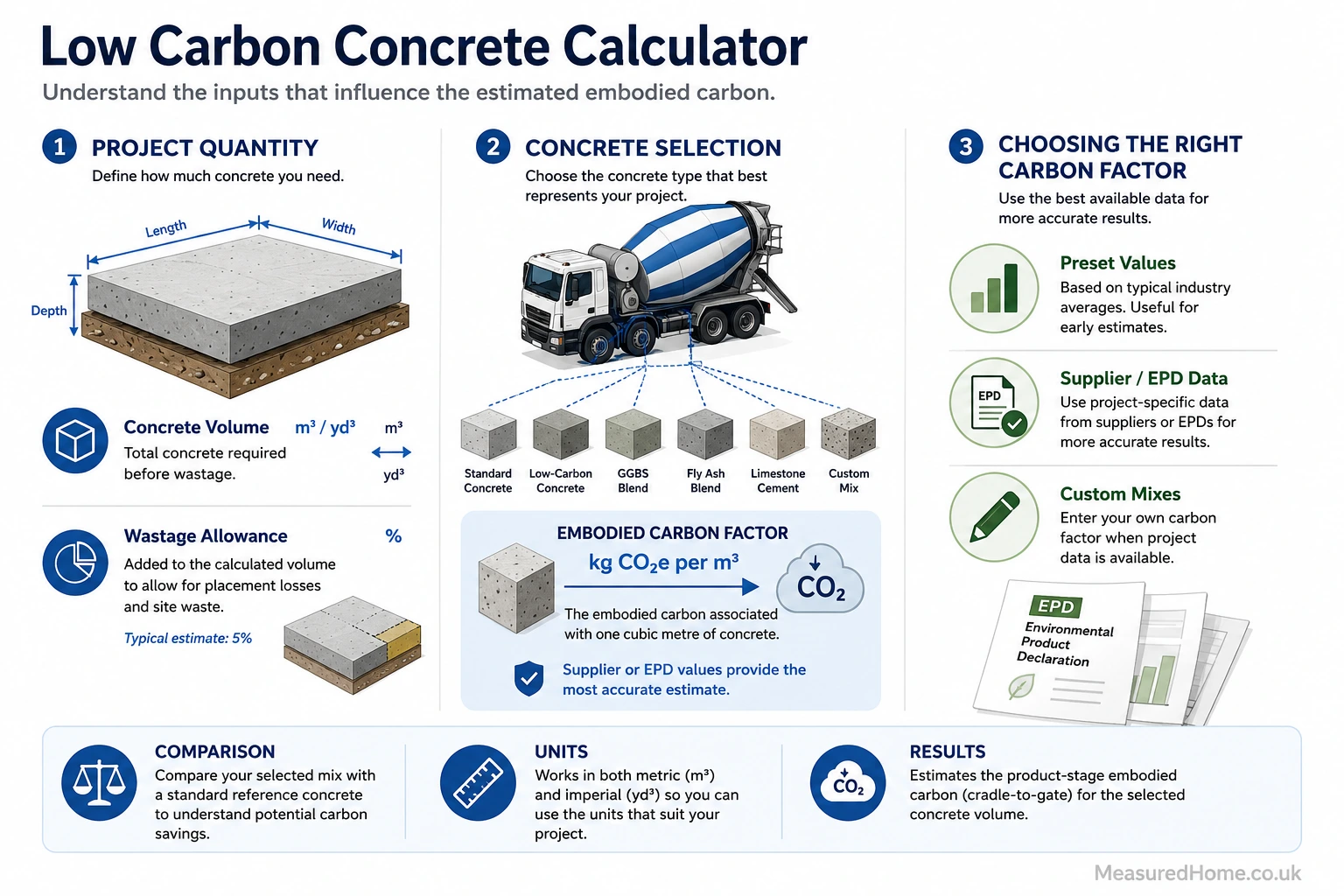
How to Use this Low-Carbon Cement Calculator
Choose the unit system
Metric mode uses cubic metres (m³) and a cost in pounds per cubic metre. Imperial mode uses cubic yards (yd³) and a cost in pounds per cubic yard. The calculator converts between the two systems when the unit selection changes.
Enter the project volume
Enter the total concrete volume before adding wastage. Use the quantity from your take-off, drawings or volume calculation. The input must be greater than zero. If you don’t already know the concrete volume for your project, use our concrete calculator to calculate it from your dimensions first.
Set the wastage allowance
The default wastage allowance is 5%. You can enter any value from 0% to 30%. The allowance increases the entered volume before carbon and cost are calculated. Use a figure that reflects the pour, access, formwork, overbreak risk and ordering method.
Select the concrete type
The available presets are Standard Concrete, Low-Carbon Concrete, GGBS Blend, Fly Ash Blend, Limestone Cement Concrete and Custom Concrete. Selecting a preset fills an illustrative embodied carbon factor in kilograms of carbon dioxide equivalent per cubic metre (kg CO₂e/m³). You can edit the factor to match supplier, EPD, regional or project data.
Use a custom mix
Choose Custom Concrete to enter a project-specific name and carbon factor. This is useful when comparing named supplier mixes, different cement replacement levels or alternative specifications.
Compare with standard concrete
Turn on the comparison option to enter a standard reference factor. The default reference factor is 300 kg CO₂e/m³. The calculator then estimates the reference carbon, total saving, percentage reduction and saving per cubic metre.
Add a concrete cost
Enter a cost per cubic metre or cubic yard to estimate the material cost for the volume, including wastage. This field is optional and should normally use the quoted concrete supply price. Delivery, waiting time, pumping, reinforcement, labour, formwork, testing and other project costs are not added automatically.
Results Explanation
Estimated Embodied Carbon: the adjusted concrete volume multiplied by the selected embodied carbon factor. Smaller totals are displayed in kilograms and larger totals may be displayed in tonnes of CO₂e.
Base Concrete Volume: the volume entered before wastage.
Volume With Wastage: the base volume increased by the selected wastage percentage.
Concrete Type: the selected preset or custom mix name.
Embodied Carbon Factor: the factor used for the selected concrete, shown in kg CO₂e/m³.
Standard Concrete Estimate: the carbon estimate produced using the comparison reference factor.
Estimated Carbon Saving: the difference between the standard reference estimate and the selected mix. A negative result means the selected mix has a higher factor than the reference.
Carbon Reduction: the saving expressed as a percentage of the standard reference estimate.
Carbon Saving Per m³: the difference between the reference factor and selected factor for each cubic metre.
Estimated Concrete Cost: the adjusted volume multiplied by the entered unit cost. This appears only when a cost is supplied.
How the Maths Works
The calculator converts all volume and cost inputs to a cubic-metre basis for the calculation. One cubic metre is treated as 1.30795062 cubic yards.
Adjusted volume = base volume × (1 + wastage percentage ÷ 100)
Estimated embodied carbon = adjusted volume × embodied carbon factor
When comparison is enabled, the standard reference estimate is the adjusted volume multiplied by the reference factor. The carbon saving is the reference estimate minus the selected mix estimate.
Carbon reduction (%) = carbon saving ÷ reference estimate × 100
Estimated material cost = adjusted volume × cost per m³
For imperial cost inputs, the calculator converts the entered pounds per cubic yard to an equivalent pounds-per-cubic-metre rate before calculating the total.
Common Mistakes to Avoid
- Entering a slab area instead of a concrete volume. Convert length × width × depth to cubic metres first.
- Adding wastage to the volume before entry and then applying the calculator’s wastage allowance as well.
- Treating the built-in factors as verified product values. They are illustrative starting points and should be replaced where reliable project data is available.
- Comparing factors that use different declared units or life-cycle assessment boundaries.
- Using a low-carbon mix without confirming strength, early-age performance, exposure class, finish and curing requirements.
- Assuming the cost result is a fully installed price. It covers only the entered concrete unit rate applied to the adjusted volume.
- Ignoring delivery logistics, minimum loads, part-load charges, pump access, and pour sequencing when ordering concrete.
- Rounding the order quantity down. Concrete shortages during a pour can cause delays, cold joints and extra delivery costs.
faqs
What is low-carbon concrete?
Low-carbon concrete is designed to reduce embodied greenhouse-gas emissions compared with a conventional reference mix. This may be achieved through cement replacement, alternative binders, optimised mix design, lower-carbon cement, recycled constituents or more efficient production. The mix must still meet the project’s performance and durability requirements. If you want to calculate the cement, sand, aggregate and water quantities for a concrete mix, use our concrete mix calculator.
How much carbon is embodied in concrete?
The result varies with cement content, binder type, strength, constituents, production energy, transport and the assessment boundary. Use a supplier-specific EPD or verified project value wherever possible rather than relying on a generic benchmark.
Does GGBS always reduce concrete carbon?
GGBS can reduce the cement-related impact of a concrete mix, but the actual benefit depends on the replacement level, source data, allocation method, mix design and transport. It may also affect early strength and programme, so the structural designer and supplier should confirm suitability.
Can low-carbon concrete be used for foundations and structural work?
Potentially, yes, provided the specified mix meets the required strength, exposure, durability, consistency and construction programme. Structural concrete should be selected and approved by the relevant designer and supplied to the applicable project specification. If you’re estimating concrete for foundations, use our concrete footing calculator to calculate the required concrete volume before comparing the embodied carbon of different mixes.
How can I reduce concrete use as well as concrete carbon?
Accurate design, efficient structural layouts, avoiding unnecessary thickness, reusing existing structures and reducing over-ordering can all help. Material substitution should not compromise safety, durability, moisture control or regulatory compliance.
What carbon factor should I enter?
Enter a factor in kg CO₂e per m³ that is appropriate for the exact mix and assessment purpose. Prefer a current supplier EPD or project-specific value. Check the declared unit and life-cycle modules before comparing it with another factor.
What does the standard reference factor mean?
It is the benchmark used for the comparison. The calculator defaults to 300 kg CO₂e/m³, but this is an illustrative value. Replace it with a suitable baseline for the project, procurement exercise or design comparison.
Does the calculator include transport, reinforcement or formwork?
No. The calculator estimates product-stage embodied carbon from concrete volume and the selected carbon factor. Whether transport is included depends on the source of the factor. Reinforcement, formwork and other materials are not added unless they are already included within the factor, which should be checked carefully.
related calculators
Concrete Weight Calculator
Concrete Bags Calculator
disclaimer
This calculator provides an estimate only and is not a substitute for an EPD, whole-life carbon assessment, structural design, specification or supplier quotation.
The preset carbon factors are illustrative starting values: Standard Concrete 300, Low-Carbon Concrete 225, GGBS Blend 210, Fly Ash Blend 230 and Limestone Cement Concrete 260 kg CO₂e/m³. Actual impacts vary by mix design, strength, constituents, cement replacement, production site, declared assessment boundary, transport and supplier. Confirm that any comparison uses compatible declared units, life-cycle modules and data quality.
The cost estimate covers only the entered concrete unit rate and adjusted volume. It excludes VAT unless included in the rate and does not automatically include delivery, part-load charges, waiting time, pumping, testing, labour, reinforcement, formwork or plant. Concrete specifications for structural, fire, durability or exposure requirements should be confirmed by a competent designer and supplier. Follow site safety procedures and current product guidance when placing, pumping, vibrating, finishing and curing concrete. Wet cementitious materials can cause serious skin and eye injury. Where Building Regulations, planning conditions, warranties or third-party certification apply, obtain appropriate professional advice and sign-off.