Concrete Column Calculator
Estimate concrete volume, ready-mix order quantity, bags, weight and material cost for circular, square, rectangular or tapered columns.
- Waste: 10%
- Internal void or deduction per column: none
- Concrete density: 2,400 kg/m³
- Ready-mix rounding: exact
- Whole bags are rounded up using a yield of 10 L .
Use this concrete column calculator to estimate the net concrete volume, extra allowance, final concrete requirement, ready-mix order quantity or number of premixed bags for one or more groups of columns. It supports metric and imperial dimensions, optional costs, practical ready-mix rounding, internal void deductions and an optional weight estimate.
PRO TIP: Measure the finished internal dimensions of the formwork rather than relying only on nominal timber or block sizes. For several identical columns, measure one carefully and use the quantity field. Before ordering ready-mix, confirm the supplier’s minimum load, delivery access, part-load charge, discharge time and available order increments. For bagged concrete, check the manufacturer’s stated yield because it can vary by product and water content.
How to use this calculator
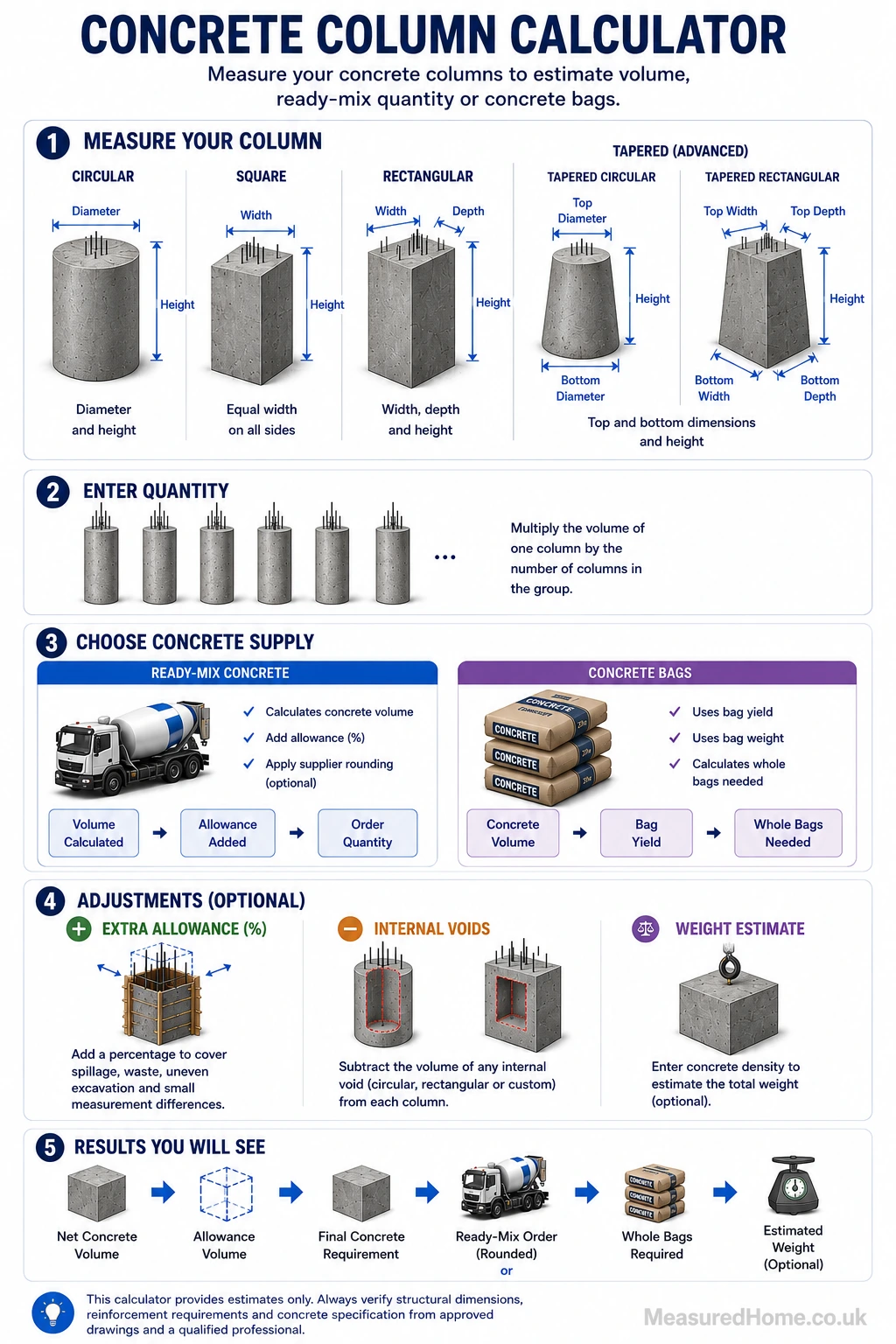
Choose Metric or Imperial units, then select the column shape and enter its dimensions, height and quantity. Available shapes include circular, square, rectangular and tapered columns.
Choose ready-mix or premixed bags and enter optional material prices. For bagged concrete, select a preset or enter the manufacturer’s stated bag weight and yield.
Add an extra allowance for losses and variations during the pour. The calculator defaults to 10%, but this can be adjusted to suit the project.
Use Advanced Mode to calculate multiple groups of different columns, deduct internal voids, round ready-mix quantities to supplier order increments or estimate concrete weight.
If you need a more detailed weight calculation using different concrete densities, reinforcement weight or load limits, use our concrete weight calculator.
Results Explanation
Concrete Required: the main purchasing figure. It shows the rounded ready-mix order or the number of whole bags, depending on the supply method.
Column Groups: the number of separate groups entered in Advanced mode.
Total Columns: the combined quantity across all groups.
Net Concrete Volume: the volume of all columns after any internal void deduction, but before the extra allowance.
Allowance Volume: the additional concrete created by the selected percentage.
Calculated Requirement: net volume plus allowance, before any ready-mix order rounding.
Ready-Mix Order: the calculated requirement rounded up using the selected increment, where enabled.
Whole Bags to Buy: the calculated volume converted to litres and divided by the bag yield, rounded up to a whole bag.
Estimated Weight: either the rounded ready-mix volume multiplied by density, or whole bags multiplied by bag weight.
Estimated Cost: ready-mix order volume multiplied by the entered unit price, or whole bags multiplied by the entered cost per bag.
Column Breakdown: the calculated volume for each group, including its quantity and dimensions.
Assumptions: a summary of the allowance, deduction, density, bag yield and order-rounding settings used.
How the Maths Works
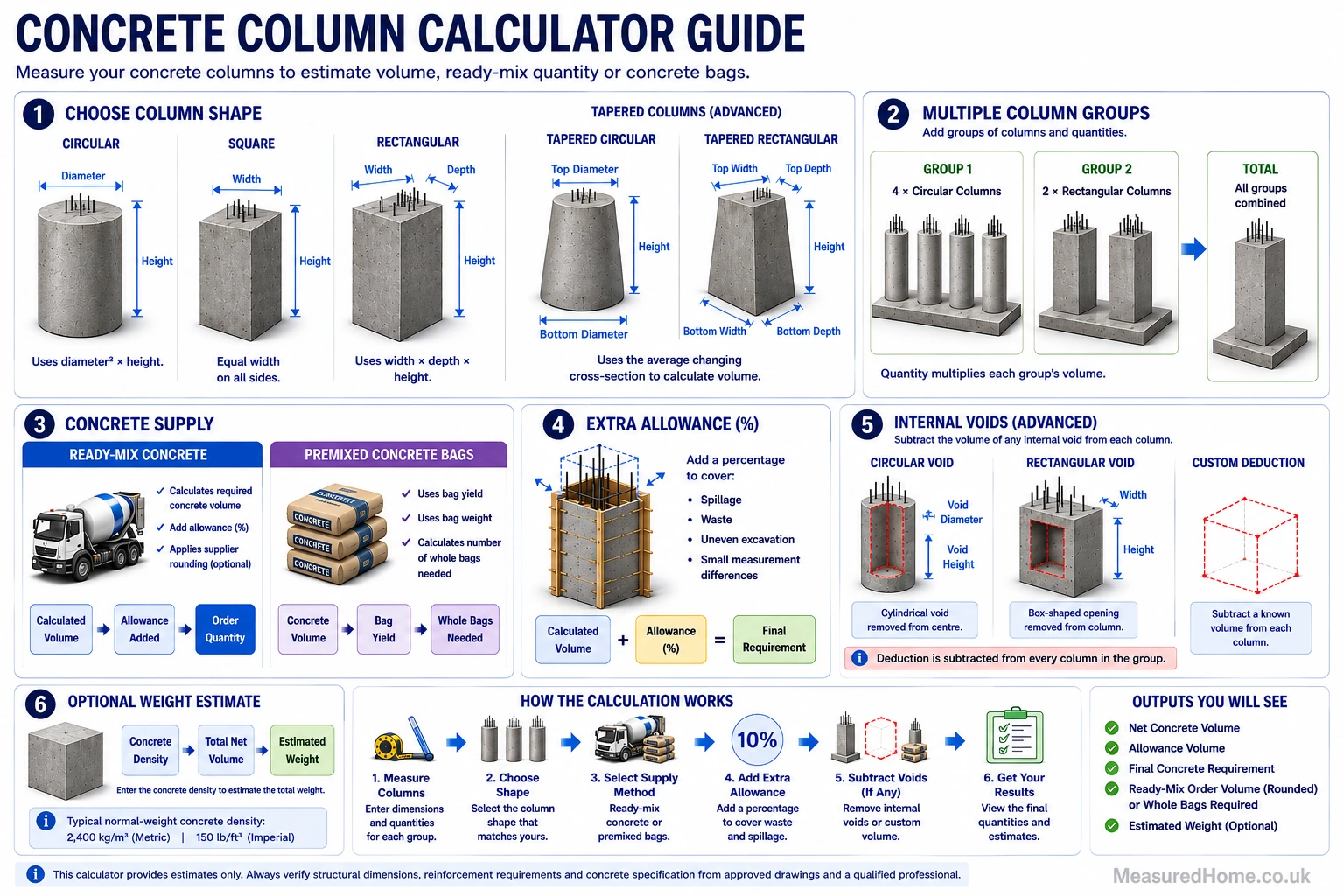
The calculator converts all dimensions internally to metres and calculates volume in cubic metres. It calculates the gross volume of one column, subtracts any selected void volume per column, multiplies by the quantity and then totals all groups.
Straight columns
Circular column: volume = π × (diameter ÷ 2)² × height.
Square column: volume = width² × height.
Rectangular column: volume = width × depth × height.
Tapered columns
A tapered circular column is treated as a conical frustum. Its volume is π × height × (bottom diameter² + bottom diameter × top diameter + top diameter²) ÷ 12.
A tapered square or rectangular column uses the prismoidal frustum relationship: height × (bottom area + √(bottom area × top area) + top area) ÷ 3.
Deductions, allowance, bags, cost and weight
Net volume per column = gross column volume − internal void or custom deduction.
Allowance volume = total net volume × allowance percentage ÷ 100.
Calculated requirement = total net volume + allowance volume.
Whole bags = calculated requirement in litres ÷ stated bag yield, rounded up.
Ready-mix cost = priced order volume × entered price per m³ or yd³.
Bag cost = whole bags × entered cost per bag.
Ready-mix weight = rounded order volume × entered concrete density.
Bagged-concrete weight = whole bags × bag weight.
Ready-mix rounding always rounds upwards. Available options include the exact calculated volume, 0.1 or 0.25 cubic metre or cubic yard increments, and 0.5 cubic yard increments.
Common Mistakes to Avoid
- Mixing millimetres and metres when entering dimensions.
- Using radius instead of diameter for a circular column.
- Entering the outside size of permanent formwork when the concrete fills a smaller internal space.
- Forgetting to multiply identical columns by using the quantity field.
- Applying an internal void deduction that is larger than the gross column volume.
- Assuming every bag of the same weight has the same mixed yield.
- Ignoring ready-mix supplier minimum loads or rounding rules.
- Using the calculated concrete quantity as a structural design check.
- Underestimating losses from awkward access, deep pours, leakage or uneven formwork.
- Ordering before reinforcement, formwork, access, and pour sequencing has been checked.
FAQs
How much concrete do I need for a circular column?
Multiply π by the square of half the diameter, then multiply by the height. This calculator performs the conversion and calculation automatically and can multiply the result by the number of identical columns.
How much extra concrete should I allow?
A 5% to 10% allowance is common for straightforward work, but the appropriate figure depends on measuring accuracy, formwork quality, access, spillage and the supplier’s ordering increments. The calculator defaults to 10%, which you can change.
Is ready-mix or bagged concrete better for columns?
Bagged concrete can suit small jobs where access is limited, while ready-mix is usually more practical for larger total volumes and continuous pours. Compare total volume, labour, mixing capacity, delivery access and supplier charges before deciding.
How many bags of concrete make one cubic metre?
The answer depends on the mixed yield stated by the manufacturer. At a 10 litre yield, approximately 100 bags are needed for 1 m³ before any allowance. At 13 litres, about 77 bags are needed, and at 15 litres, about 67 bags. Whole-bag rounding increases the purchase quantity. For a more detailed estimate based on your actual project volume and bag yield, use our concrete bags calculator to calculate whole bags, supplied volume, total weight and leftover concrete.
Can I calculate several different column sizes together?
Yes. Switch to Advanced mode and add a separate column group for each size or shape. The calculator totals the groups and provides an individual volume breakdown.
Does the result include reinforcement or formwork?
No. The result estimates concrete volume, bags, weight and optional material cost only. If your column design specifies reinforcement, use our rebar calculator to estimate the quantity, length and weight of rebar required.
What concrete strength should I use for a structural column?
Concrete strength, reinforcement, cover, column size and foundation design should be specified for the particular structure. Seek a structural engineer’s design and follow the project specification rather than selecting a mix solely from a volume calculator.
related Calculators
Concrete Footing Calculator
Concrete Calculator
Disclaimer
This calculator provides an estimate based on the dimensions, quantities, yields, prices, density and allowances entered. Actual material use can differ because of measurement error, formwork movement or leakage, irregular surfaces, batching variation, spillage and site conditions.
Check all measurements before purchasing materials. Confirm bag yield and mixing instructions with the product manufacturer, and confirm minimum loads, order increments, delivery charges and access requirements with the ready-mix supplier.
The calculator is not a structural design tool. Structural columns, load-bearing piers, foundations, reinforcement and alterations to buildings may require design by a suitably qualified structural engineer, compliance with the Building Regulations and approval or inspection by the relevant building control body. Follow the project drawings, specifications, temporary works requirements and safe working procedures.
Concrete and cement products can cause serious skin and eye injury. Wear suitable personal protective equipment, avoid prolonged skin contact, control dust, use safe lifting and mixing methods, and follow the manufacturer’s safety data and handling instructions.