Concrete Block Fill Calculator
Estimate how much concrete or grout you need to fill concrete block walls, including project presets, openings, waste and bag counts.
- Project type: Fence wall
- Fill pattern: 24 inch centers
- Block thickness: 8 inch block
- Fill factor: —
- Waste allowance: 10%
- Bag yield: 25 kg bag ≈ 0.012 m³
- Bag counts are rounded up to the next whole bag.
- Presets are planning assumptions only. Reinforcement and grout requirements vary by engineering specification and local building codes.
Use this concrete block fill calculator to estimate the concrete or grout required to fill hollow concrete block walls. Calculate from wall dimensions or a known number of blocks, then choose the block thickness and fill pattern.
The calculator estimates fill volume, wastage, ready-mix quantity, bag quantities and optional material costs.
PRO TIP: For small jobs, bagged material can be convenient because you can mix as you go and buy a little extra. For larger filled block walls, compare bagged material against ready-mix or pumpable grout, especially where access, working time and labour matter. Always check the mixed yield on the bag or supplier data sheet, as yield can vary between products.
How to Use this Concrete Block Fill Calculator
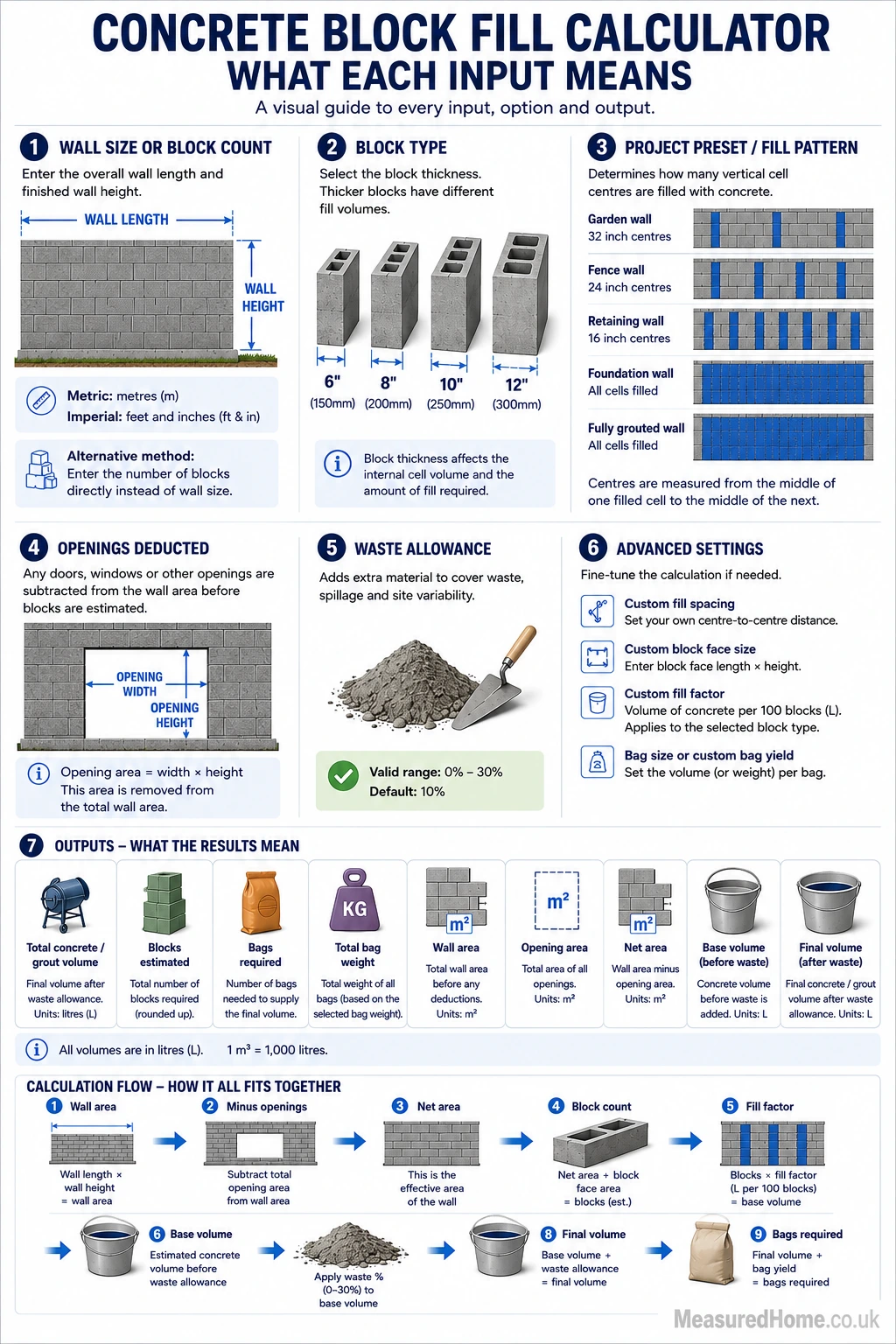
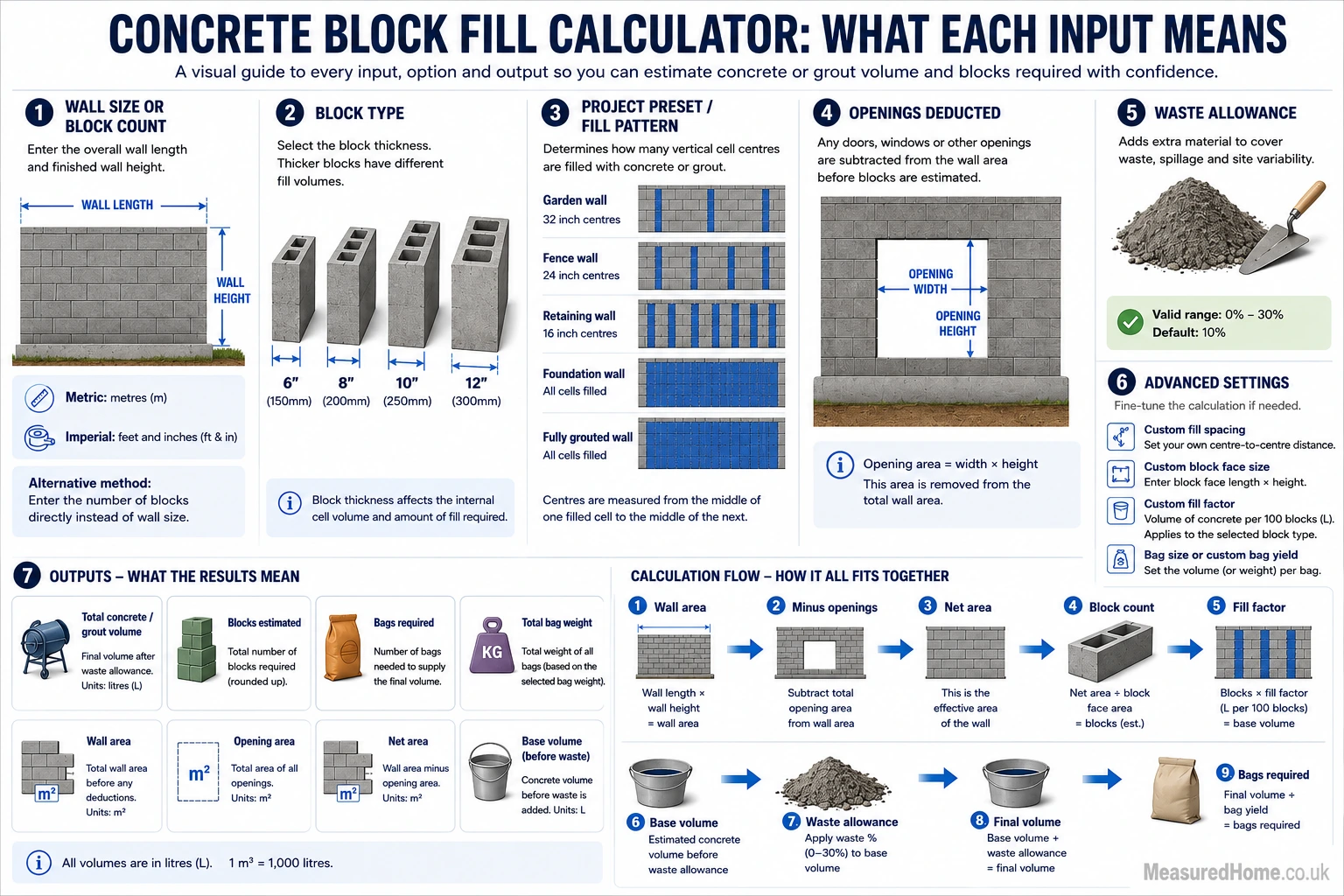
Choose whether to calculate from wall dimensions or a known block count. For wall dimensions, enter the wall length and height and deduct any gates, doors, windows or other openings.
Select the block thickness and the closest project type. The project type determines the default fill pattern, from partially filled cells to fully grouted walls. These presets are for estimating only; use the fill pattern specified in your drawings or structural design where applicable.
Choose your bag size and wastage allowance, then enter optional bag or bulk concrete/grout prices to compare material costs.
Use Advanced mode to enter a custom fill pattern, block dimensions or supplier-specific fill factor.
If you want to calculate the number of concrete blocks required for a project, use our concrete block calculator.
Results Explanation
The main result is the estimated fill volume, including waste. In metric mode, this is shown in cubic metres, with supporting values in litres. In imperial mode, the main volume is shown in cubic yards, with supporting values in cubic feet.
The bag count is rounded up to the next whole bag, because you cannot normally buy a fraction of a bag. The total bag weight is calculated from the selected bag size where a standard bag preset is used. If a custom bag yield is entered, the calculator can estimate the number of bags, but does not know the bag weight.
The wall area result shows the gross wall area when wall dimensions are used. The opening area result shows how much area has been deducted. The net wall area is the remaining area used to estimate block count. If you calculate from block count, the wall area is estimated from the number of blocks and the block face size.
The base fill volume is the calculated concrete or grout volume before waste. The volume with waste includes the selected waste allowance. The ready-mix volume uses the same waste-adjusted volume.
Cost results only appear when prices are entered. If both bag and bulk prices are entered, the calculator compares the two material-only estimates and highlights the lower cost in the summary. This is a buying comparison only, not a full installed cost.
How the Maths Works
The calculator first works out the number of blocks being filled.
When using wall dimensions:
Wall area = wall length × wall height
Opening area = opening width × opening height for each opening
Net wall area = wall area − opening area
Estimated block count = net wall area ÷ block face area, rounded up
By default, the block face area is based on a standard 8 × 16-inch face size. In metric terms, that is 0.2032 m × 0.4064 m. In advanced mode, a custom block face size can be used instead.
When calculating from block count, the entered block count is used directly, and the wall area is estimated from the block count and block face area.
The selected project preset determines the fill pattern. The built-in presets use these fill patterns: garden wall at 32-inch centres, fence wall at 24-inch centres, retaining wall at 16-inch centres, and foundation or fully grouted walls with all cells filled.
The calculator then uses a fill factor for the chosen block thickness and fill pattern. The built-in fill factors are stored as cubic yards per 100 blocks, then converted internally to cubic metres. For example, an 8-inch block uses 1.00 yd³ per 100 blocks when all cells are filled, 0.58 yd³ at 16-inch centres, 0.44 yd³ at 24-inch centres and 0.38 yd³ at 32-inch centres.
Base fill volume = block count ÷ 100 × fill factor
Volume with waste = base fill volume × (1 + waste percentage ÷ 100)
Bag count = volume with waste ÷ bag yield, rounded up
Bag cost = bags required × cost per bag
Bulk concrete/grout cost = volume with waste × cost per cubic metre, or volume in cubic yards × cost per cubic yard. The calculator uses the selected unit system for display, but the core calculations are normalised internally so that metric and imperial entries are handled consistently
Common Mistakes to Avoid
- Do not use the gross wall area if there are large openings. Gates, doorways, windows and missing sections can noticeably reduce the amount of fill required.
- Do not assume every block needs filling unless the design calls for it. Many walls only have reinforced cells filled at set centres, while fully grouted or engineered walls may require all cells to be filled.
- Do not ignore waste. Spillage, uneven cells, reinforcement, overfilling, measurement differences and product yield variation can all increase the amount needed.
- Do not mix up bag weight and mixed yield. A 25 kg bag does not produce 0.025 m³ of concrete. The calculator uses mixed yield, not dry bag weight, to estimate bag count.
- Do not treat project presets as structural design advice. Retaining walls, foundation walls and reinforced walls may need engineer-specified reinforcement, concrete strength, grout type, drainage and inspection.
- Do not forget the access and placement method. Tall walls, narrow cells, congested reinforcement and long runs may need suitable grout consistency, staged pours or professional placement.
FAQs
How much concrete do I need to fill concrete blocks?
It depends on the block thickness, number of blocks and whether every cell is filled or only reinforced cells are filled at set centres. Enter the wall dimensions or block count, choose the block thickness and project type, and the calculator will estimate the base fill volume and the volume including waste.
Should all concrete block cells be filled?
Not always. Some walls only need selected cells filled around reinforcement, corners, piers or openings. Fully grouted walls and some foundation or retaining walls may require all cells to be filled. Follow the project specification, drawings or professional advice for structural work.
What waste allowance should I use for block fill?
The calculator defaults to 10%, which is a practical planning allowance for many small and medium jobs. You may want to increase the allowance if the wall has irregular cells, awkward access, heavy reinforcement, uncertain measurements or a product with variable yield.
Can I use this calculator for retaining walls?
Yes, the calculator includes a retaining wall preset based on filled cells at roughly 16-inch centres. However, retaining walls also need correct design, foundations, reinforcement, drainage and backfill. Seek professional advice where the wall retains significant ground or could affect safety. For a broader estimate of retaining wall materials, use our retaining wall calculator.
Does the calculator deduct doors, windows or gate openings?
Yes, when you calculate from wall dimensions, you can choose to deduct openings. Enter the width and height of each opening, and the calculator subtracts that area before estimating block count. When using block count, openings are not deducted because the block count should already allow for them.
Why does the calculator use inch block thicknesses for a UK page?
Concrete block thickness and fill data are often supplied using nominal inch sizes, especially for hollow concrete masonry and grout fill tables. The calculator still supports metric wall measurements, metric custom block dimensions, cubic metre outputs and GBP cost fields for UK users.
Is ready-mix cheaper than bags for filling block walls?
It depends on job size, delivery, minimum order charges, access and labour. The calculator can compare material-only costs if you enter a cost per bag and a cost per cubic metre or cubic yard. For larger volumes, bulk supply may be more practical, but delivery and placement costs can change the final decision. If you’re using bagged concrete, use our concrete bags calculator for a more detailed estimate of bag quantities, supplied volume, total weight and leftover material.
Does this calculator cover reinforcement, foundations or Building Regulations?
No. It estimates concrete or grout quantity only. If your design specifies reinforcement, use our rebar calculator to estimate the quantity, length and weight of rebar required. For structural walls, retaining walls, foundations or walls near boundaries and buildings, check the relevant UK requirements and get competent professional advice where needed.
Related calculators
Concrete Footing Calculator
Garden Wall Calculator
Mortar Calculator
disclaimer
This calculator is for estimating material quantities only. It is not a structural design tool and should not be used as the sole basis for safety-critical work.
The results depend on the accuracy of your measurements, the chosen block thickness, the fill pattern, the bag yield and the waste allowance. Always check product data sheets and supplier guidance before ordering.
For retaining walls, foundation walls, reinforced walls, walls supporting loads or walls where failure could cause injury or damage, obtain appropriate professional design or sign-off. Also, check any applicable planning, Building Regulations, Party Wall and site safety requirements before starting work.
Concrete and grout are heavy, alkaline materials. Wear suitable PPE, handle bags safely, avoid skin and eye contact, and follow the manufacturer’s mixing and curing instructions.