Brick Calculator
Estimate bricks for your wall — from simple DIY projects to full trade builds.
- Standard UK brick face: 215 × 65 mm
- Mortar joint thickness: 10 mm
- Wastage allowance: 5%
- Wall thickness: Half brick wall
- Bricks per pack: —
Use this brick calculator to work out how many bricks you need for a wall, whether you’re building a simple garden wall or a larger structure.. The calculator helps you estimate the number of bricks required, including optional wastage, so you can plan your project and order the right quantity of materials. It also provides a quick guide to common brickwork figures, such as bricks per square metre.
Simply enter the wall height and wall length, select the brick dimensions, and adjust the mortar joint thickness if required. The calculator will then estimate the total number of bricks needed for the wall area you are building.
This brick calculator is designed around standard UK brick sizes and typical brickwork practices used by builders, tradespeople and DIY enthusiasts
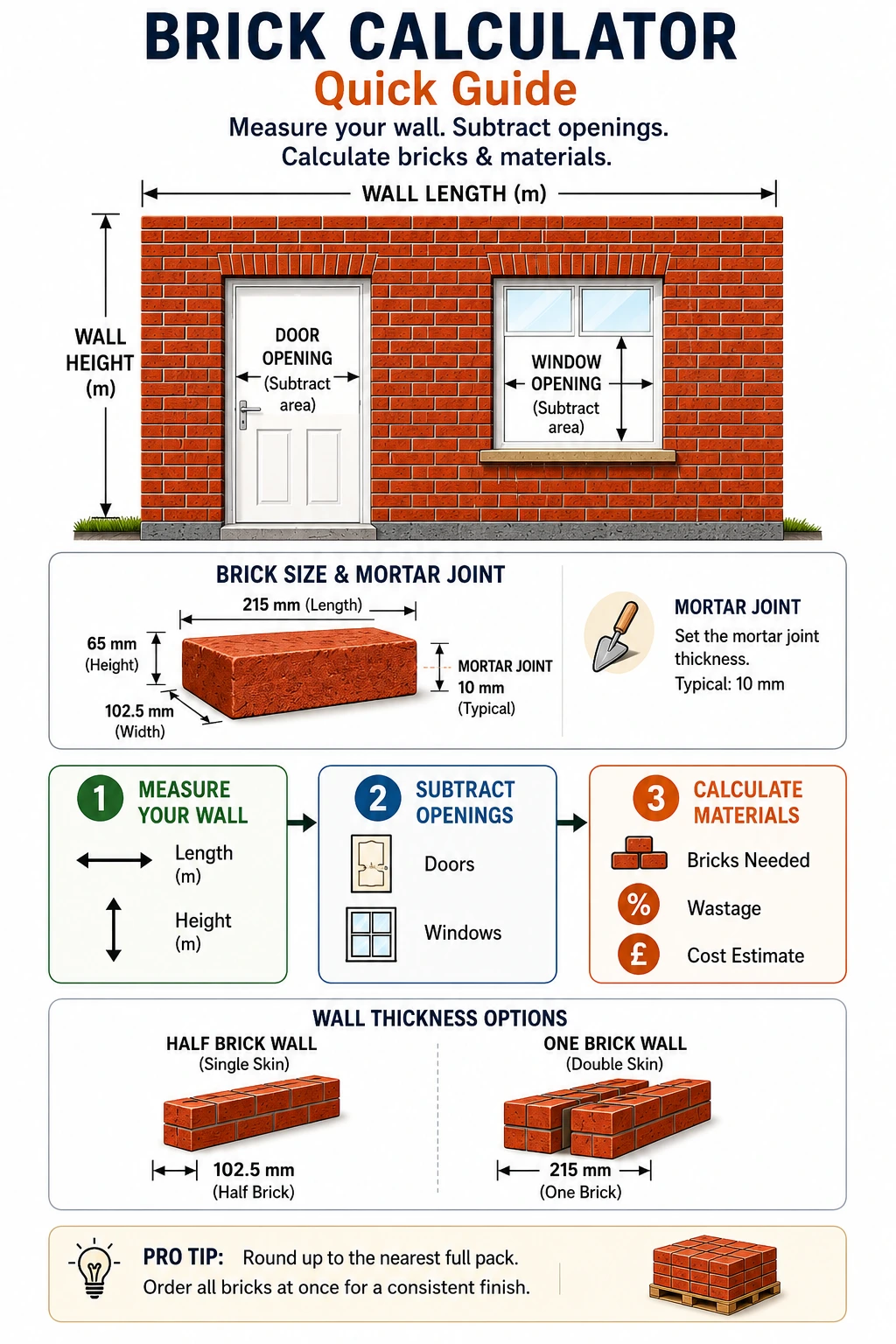
PRO TIP: When ordering bricks, always round up to the nearest full pack. Bricks from different batches can vary slightly in colour, so ordering everything at once helps ensure a consistent finish.
How to use the brick calculator
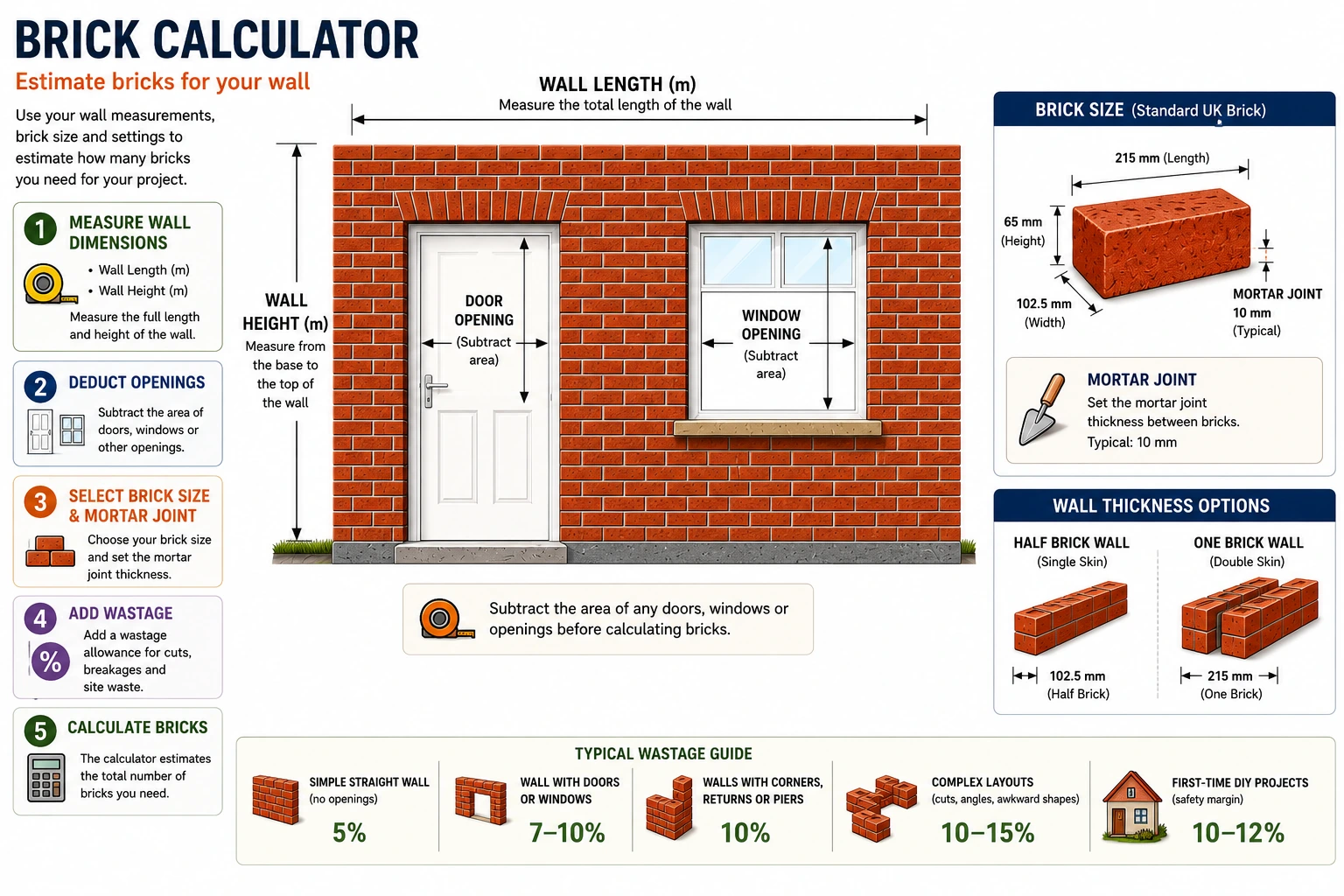
Follow these steps to calculate the bricks needed for your project:
- Enter the wall height and wall length.
- Select the brick size or enter custom brick dimensions.
- Adjust the mortar joint thickness if required.
- Add an optional wastage percentage.
- The calculator will estimate the total number of bricks required.
How Many Bricks Do I need for a wall?
The number of bricks required for a wall depends on the total wall area and the size of the bricks being used. To estimate how many bricks are needed, you first calculate the wall area and then divide it by the face area of a brick, including the mortar joint.
The basic calculation is:
Bricks needed = Wall area ÷ Brick face area, including mortar
The wall area is calculated by multiplying the wall height by the wall length. Once the wall area is known, the number of bricks required can be estimated based on the brick dimensions and mortar joint thickness.
Most builders also include additional bricks for wastage when ordering materials. This helps account for damaged bricks, cutting at the ends of walls and other small losses during construction.
Deducting Doors and Windows (Openings)
When calculating how many bricks you need for a wall, it’s important to account for any openings such as doors, windows or large gaps. These areas do not require bricks, so failing to deduct them can lead to over-ordering materials.
To get an accurate estimate, first calculate the full wall area using the total height and length. Then subtract the area of each opening before working out the number of bricks required.
The adjusted formula becomes:
Adjusted wall area = Total wall area − Opening area
For example, if your wall is 10 m² and you have a window that measures 1 m², the effective wall area becomes 9 m². This reduced area is then used to calculate how many bricks are needed.
If you are using the Advanced mode in this calculator, you can enter openings directly, and the deduction will be applied automatically.
Recommended Brick & Block Wastage Allowance
To avoid running short on materials, it’s important to include a wastage allowance. The table below shows typical recommendations based on wall complexity.
| Wall Type | Recommended Wastage |
|---|---|
| Simple straight wall (no openings) | 5% |
| Wall with doors or windows | 7–10% |
| Walls with corners, returns or piers | 10% |
| Complex layouts (cuts, angles, awkward shapes) | 10–15% |
| First-time DIY projects (safety margin) | 10–12% |
Standard UK Brick Sizes
Most brickwork projects in the UK use a standard facing brick size. The most common brick dimensions are:
215 mm × 102.5 mm × 65 mm
(length × width × height)
These dimensions are widely used across residential construction, and many brick calculators use this size as the default setting.
The width of the brick does not affect how many bricks are required per square metre because the visible wall surface is determined by the brick length and height.
Some bricks may vary slightly depending on the manufacturer or the type of brick being used, so measuring the brick dimensions before calculating materials can improve accuracy.
Common Brick Types in the UK
While most brick calculators use standard dimensions, the type of brick you choose can affect how your wall performs.
- Facing bricks – used for external walls where appearance is important
- Engineering bricks – high-strength bricks used for structural and load-bearing applications
- Common bricks – general-purpose bricks used where the finish is less important
For quantity calculations, most standard bricks share the same face dimensions, so the number of bricks required per square metre remains similar.
How Many Bricks Per Square Metre?
A common rule used when estimating brickwork is the number of bricks per square metre of wall.
For a wall built with standard UK bricks and a 10 mm mortar joint, the typical values are:
Approximately 60 bricks per m² for a single-skin or half-brick wall.
Approximately 120 bricks per m² for a double-skin or one-brick wall.
The exact figure varies with brick dimensions, mortar joint thickness and wall type.
If you’re calculating materials for a cavity wall rather than a single leaf of brickwork, use our cavity wall calculator to estimate the bricks, blocks, insulation, wall ties and mortar together.
Mortar joint thickness explained
A mortar joint is the layer of mortar between bricks that bonds them together and creates consistent spacing within the wall.
In most brickwork projects, the typical mortar joint thickness is 10 mm. Mortar joints slightly increase the effective size of each brick when calculating how many bricks are required for a wall.
If the mortar joint is thicker, fewer bricks may be needed because each brick course occupies more space. If the mortar joint is thinner, the number of bricks required may increase slightly.
Brick calculators include the mortar joint thickness in the calculation, so the final brick estimate more accurately reflects the wall being built.
If you’re repairing existing mortar joints rather than building new brickwork, use our repointing calculator.
How much mortar do you need?
Brickwork requires mortar made from a mixture of cement, sand and water. The exact quantity of mortar needed depends on the size of the wall, the brick dimensions and the mortar joint thickness.
As a general guide, around 0.4 to 0.5 cubic metres of mortar is required for every 1000 standard bricks. Mortar is typically mixed using a cement to sand ratio of around 1:5 for general brickwork.
If you need to calculate mortar at the same time as calculating your brick quantities, you can use our mortar calculator to estimate the mortar, cement and sand required for your wall.
Why add wastage when calculating bricks?
When calculating brick quantities, it is common practice to include a wastage allowance. This extra percentage helps cover bricks that may break during transport, cutting or installation.
Typical wastage allowances range from 5% to 10%, depending on the complexity of the wall and the experience of the builder.
Brick Calculation Formula
Brick calculators estimate quantities using the wall area and the size of each brick, including the mortar joint.
The typical formula used is:
Bricks needed = Wall area ÷ Brick face area, including mortar
Where:
- Wall area = wall height × wall length
- Brick face area = (brick length + mortar joint) × (brick height + mortar joint)
FAQS
How many bricks are required for a 4 × 4 metre wall?
A wall measuring 4 metres by 4 metres has a total area of 16 square metres. Using a guide of approximately 60 bricks per square metre, this wall would require around 960 bricks before adding wastage.
Most builders include an additional 5–10% allowance for wastage, meaning the total order may be closer to 1000 bricks depending on cutting and breakages during construction.
How many bricks are needed for 1 cubic metre of brickwork?
A cubic metre of brickwork typically requires around 500 standard bricks, depending on the brick dimensions and mortar joint thickness used. This estimate assumes common UK brick sizes and standard mortar joints used in general brickwork.
Do I need to deduct doors and windows from my brick calculation?
Yes, openings such as doors and windows should be deducted from the total wall area to avoid overestimating materials.
If you calculate the full wall without removing these areas, you will end up ordering more bricks than necessary. Most builders calculate the full wall first and then subtract openings for a more accurate result.
Can I use this calculator for blocks as well as bricks?
This calculator is designed primarily for standard brick sizes. However, if you are building with concrete or breeze blocks, you should use a dedicated block calculator to get accurate results based on block dimensions and coverage rates.
Does mortar joint thickness affect how many bricks I need?
Yes, mortar joint thickness has a direct impact on brick quantity.
Thicker joints increase the overall size of each course, meaning fewer bricks are needed per square metre, while thinner joints increase the number of bricks required. Even small changes in joint size can affect totals across larger walls.
Why does my brick calculation differ from a builder’s estimate?
It’s common for builder estimates to be higher than a basic calculation because professionals factor in additional wastage from cuts and breakages, allow for extra materials needed around corners and edges, and account for site conditions and handling losses.
A calculator provides a reliable estimate, but builders tend to be more conservative to avoid running short on materials.
Related Calculators
Concrete Footing Calculator
Wall Tie Calculator
Disclaimer
This calculator provides estimates for informational purposes only and does not constitute professional advice. Actual material requirements may vary based on site conditions, construction methods, and brick batch variations. Always consult with a qualified professional or your material supplier before placing an order.