Self-Levelling Compound Calculator
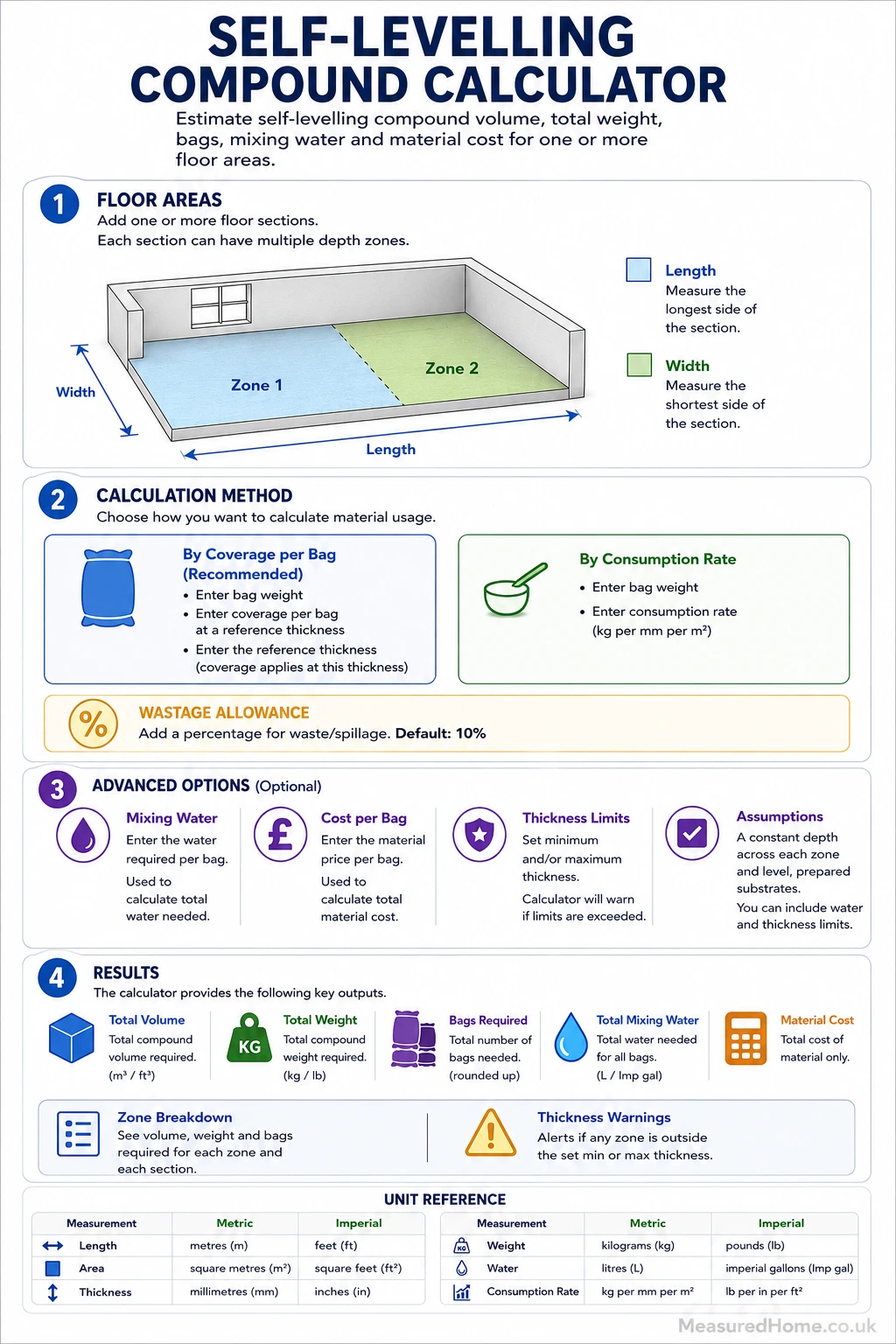
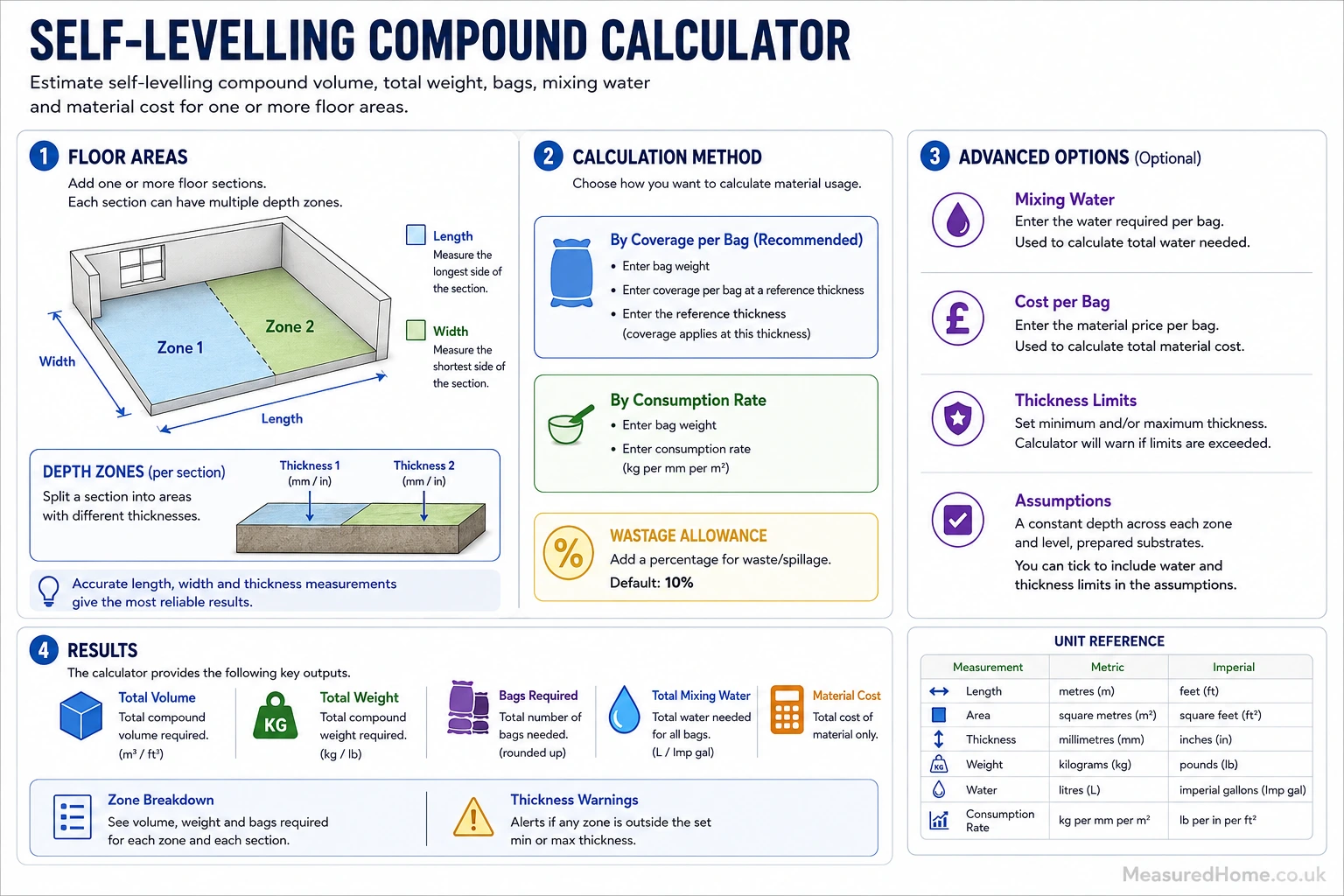
Estimate self-levelling compound volume, total weight, bags, mixing water and material cost for one or more floor areas.
- Calculation method: coverage per bag
- Waste: 10%
- Bag weight: 20 kg
- Product rate: 4 m² per bag at 5 mm
- Mixing water: not entered
- Product thickness limits: not entered
Use this self-levelling compound calculator to estimate how much floor levelling compound you need for one or more rooms or floor areas. Enter the floor dimensions or total area, subtract any sections that will not be covered, choose the required thickness, then estimate compound volume, dry weight, whole bags, mixing water and optional material cost.
PRO TIP: Measure the floor at several points before choosing a thickness. For an uneven floor, Advanced mode can divide the area into separate depth zones, which is usually more accurate than applying the deepest measurement across the whole room.
How to Use this Self-Levelling Compound Calculator
Start with the floor area that needs levelling. You can enter the length and width of a rectangular room or use a known total area, then deduct any sections that will not receive compound. Additional rooms or floor sections can be included in the same calculation.
Measure the floor at several points to determine the compound thickness required. If the depth varies significantly across the floor, Advanced Mode lets you split the area into separate depth zones rather than applying one average thickness everywhere.
Check the product packaging or technical data sheet to see whether the compound is specified by coverage per bag or consumption rate and enter the corresponding figures. Product-specific bag weights, coverage rates and water requirements can also be entered.
Finally, select a material allowance and add the price per bag if you want a cost estimate. You can also enter the manufacturer’s mixing-water quantity to calculate the total water required.
Results Explanation
The calculator shows the number of whole bags to buy, the exact bag requirement before rounding, total floor area, compound volume, dry material weight, allowance, final material weight and optional mixing water and cost.
Gross Area is the total measured area before exclusions. The excluded area is the part that will not receive the compound. Net Area is the area used in the material calculation.
Compound Volume is the space filled by the levelling compound. In metric mode, it is shown in cubic metres and litres. In imperial mode, it is shown in cubic feet and imperial gallons.
Net Material Weight is the estimated dry compound before the extra allowance. Allowance Weight is the additional material created by the selected percentage. Final Material Weight is the total after allowance.
Exact Bags is the mathematical bag requirement after allowance. Whole bags are rounded up, because self-levelling compound is normally purchased in complete bags.
The estimated cost is based on whole bags multiplied by the cost per bag. Mixing Water is based on whole bags multiplied by the water entered per bag.
In Advanced mode, the results can also show depth-zone breakdowns and warnings where an entered thickness is below the product minimum or above its maximum.
How the Maths Works
The calculator first works out the floor area and subtracts any sections that will not receive compound:
Net area = gross floor area − excluded area
For a single average thickness, compound volume is:
Volume (m³) = area (m²) × thickness (mm) ÷ 1,000
If depth zones are used, each area is calculated at its own depth, and the results are added together.
Material quantity is then calculated using the method stated by the product manufacturer. For products specified by consumption rate:
Material weight = area × depth × consumption rate
For products specified by coverage per bag, the stated coverage is adjusted to the required thickness before calculating the number of bags.
The selected allowance is added to the material requirement, and the final bag quantity is rounded up to the next whole bag.
If entered, material cost and mixing water are calculated from the final number of whole bags.
Common Mistakes to Avoid
- Do not use the deepest point as the average thickness across the whole room. Take several measurements or use depth zones.
- Do not forget to subtract areas that genuinely will not receive compound, but avoid subtracting movable furniture or sections that still need a continuous floor finish.
- Do not confuse coverage per bag with a consumption rate. Use the method and units stated on the same product packaging or technical sheet.
- Do not use a coverage figure without its reference thickness. A bag covering 4 m² at 5 mm will cover less area at a greater depth.
- Do not assume every self-levelling compound has the same bag weight, coverage, water requirement or depth limits.
- Do not add extra water to improve flow beyond the manufacturer’s permitted amount. Too much water can reduce performance and affect drying.
- Do not ignore primer, substrate preparation, movement, moisture or product compatibility.
- Do not buy only the exact decimal bag result. Bags are sold whole, so use the rounded-up whole-bag figure.
- Do not start a large pour without enough material, mixing capacity and labour to maintain the product’s working time and a continuous wet edge.
faqs
How thick should self-levelling compound be?
Use the thickness needed to correct the floor while staying within the product’s stated minimum and maximum application depths. Some compounds are intended for thin smoothing layers, while others can be applied more deeply. If you need a thicker floor build-up rather than a levelling compound, use our screed calculator to estimate screed volume and material quantities.
How much extra self-levelling compound should I allow?
The calculator offers no allowance, 5%, 10% or 15%, with 10% selected by default. A higher allowance may be sensible for rough, porous or very uneven floors, but accurate measurements remain important.
Do I need to prime before using self-levelling compound?
Many products require a compatible primer, particularly on absorbent or difficult substrates. Follow the manufacturer’s instructions for preparation, priming, drying times and substrate suitability.
Can I use self-levelling compound over timber?
Only use a product approved for the specific timber or boarded substrate. Movement and deflection must be controlled, and the system may require reinforcement, primer or a particular minimum thickness.
How do depth zones work?
Advanced mode lets you divide one floor area into zones with different depths. The zone areas must add up to the net floor area. The calculator works out each zone separately and combines the material requirements.
What is the difference between coverage per bag and consumption rate?
Coverage per bag states how much area one bag covers at a specified thickness. A consumption rate states the dry material needed per square metre for each millimetre of depth. Choose the option that matches the product data.
Does the calculator include mixing water?
Yes. Enter the manufacturer’s water quantity per bag and the calculator multiplies it by the whole-bag count. Mix each batch within the permitted water range rather than treating the total as one batch.
Related Calculators
Disclaimer
This calculator is for estimating self-levelling compound volume, dry material weight, bag quantities, mixing water and material cost only. It does not confirm that a product or floor build-up is suitable for a particular project.
Always check the current product packaging and technical data sheet for coverage, consumption, water dosage, primer requirements, substrate suitability, working time, curing time, minimum thickness and maximum thickness.
Check the floor for moisture, cracking, contamination, movement and weak or loose material before starting. Seal gaps where fluid compound could escape and protect adjoining surfaces.
For structural movement, serious substrate defects, damp floors, underfloor heating concerns or work outside the product specification, get advice from the manufacturer or a suitably qualified flooring professional.