Postcrete Calculator
Estimate the Postcrete volume, whole bags, total weight and material cost required to set fence posts.
- Hole shape: cylindrical
- Post volume: subtracted
- Bag yield: 10 L
- Extra allowance: 10%
- Whole bags are always rounded up.
Use this Postcrete calculator to estimate how many bags of Postcrete you need for fence posts, gate posts, decking supports and other non-structural post installations. Calculate the total concrete volume, exact and rounded bag quantities, purchased weight and estimated material cost using UK metric or imperial measurements.
The calculator supports square, rectangular and round posts, lets you enter measured hole dimensions or use suggested hole sizes, and includes preset or custom Postcrete bag yields for greater accuracy.
PRO TIP: Different Postcrete brands can produce different volumes from bags of the same weight. Always check the stated yield (litres) on the packaging rather than assuming every 20 kg bag covers the same amount.
How to Use This Calculator
Start by choosing either Metric or Imperial measurements. Metric is generally easier if you’ve measured everything in millimetres and metres, while Imperial is useful if you’re working from older plans or measuring in inches.
For a new straight fence run, use our fence calculator to estimate the posts, panels or individual boards needed.
Next, enter the number of posts you are installing and select the post shape. The calculator supports square, rectangular and round posts. Enter the appropriate post dimensions before adding the finished hole diameter and depth.
If you haven’t yet dug the holes, you can use the suggested hole size option as a starting point. These recommendations are intended for estimating materials only and should always be checked against the fence manufacturer’s guidance, ground conditions and the loading the post will carry.
Choose one of the built-in Postcrete presets or switch to Advanced Mode to enter your own bag yield and bag weight. This is particularly useful when using products from different manufacturers, as the amount of mixed concrete produced per bag can vary.
The calculator includes a wastage allowance to cover over-digging, uneven hole sides and small spillages. The default is 10%, although you can increase or decrease this depending on site conditions. The calculator accepts values between 0% and 100%.
If you enter a price per bag, the calculator will also estimate your total material cost.
Results Explanation
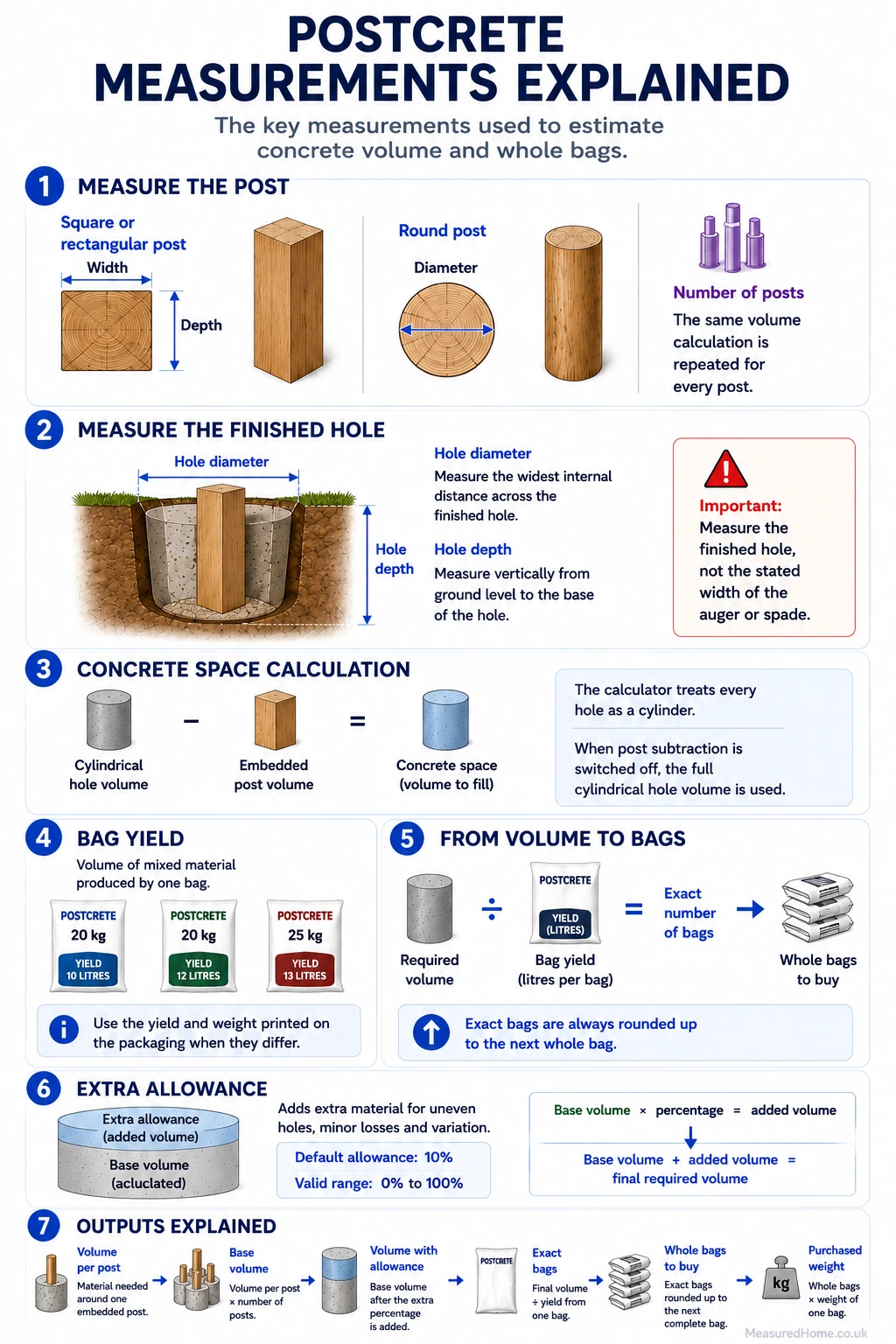
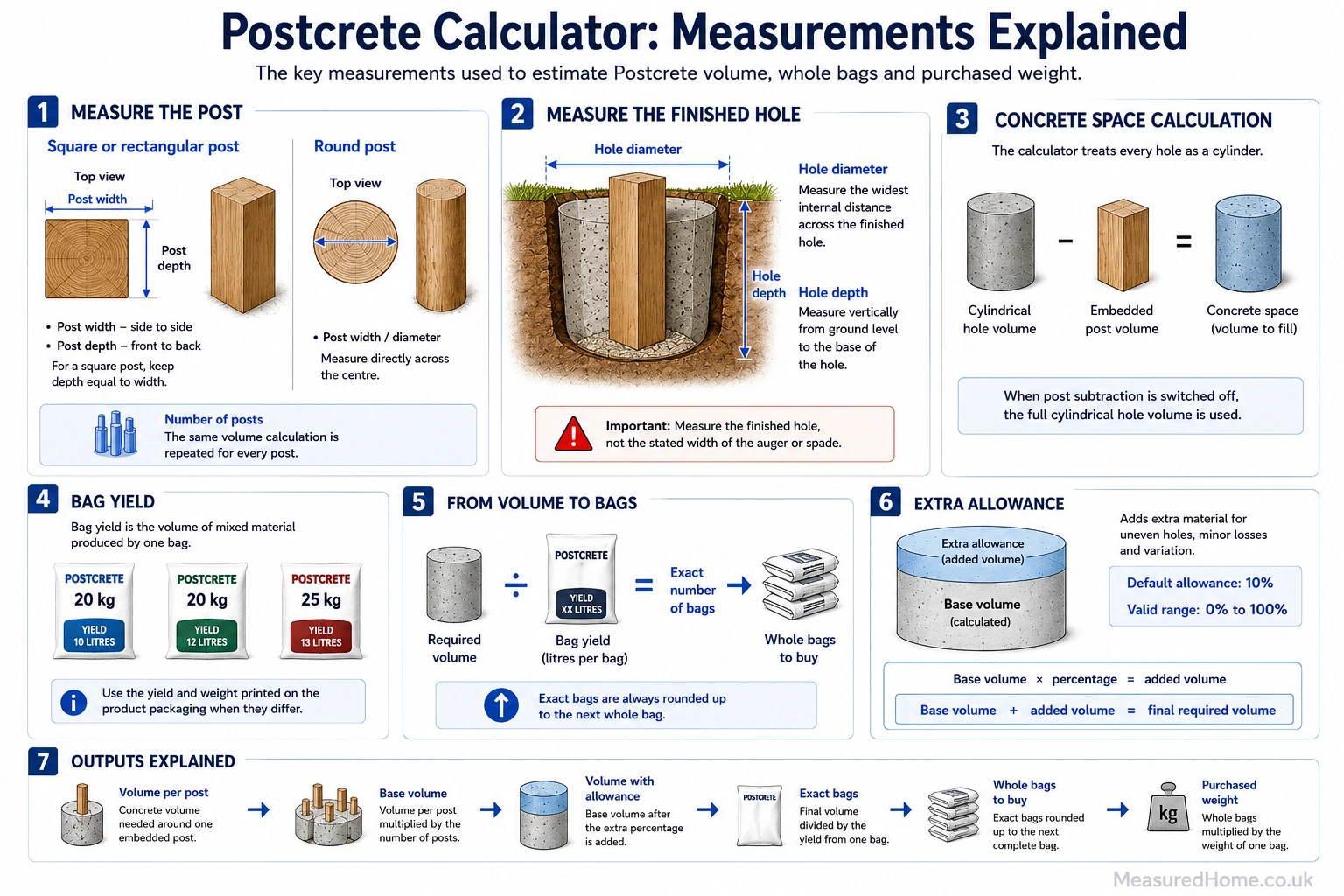
Volume per post shows how much Postcrete is required for each individual hole.
Base volume is the total concrete volume before wastage has been added.
Volume with allowance includes your selected wastage percentage to account for excavation differences and material losses.
Exact bags required shows the calculated number of bags before rounding..
Whole bags to buy rounds this figure up to the next complete bag, giving a realistic purchasing quantity.
Purchased weight calculates the combined weight of all bags, helping you plan transport and manual handling.
If you’ve entered a bag price, the calculator also estimates the total material cost. This figure covers Postcrete only and does not include delivery charges, labour or additional materials.
How the Maths Works
Each post hole is treated as a cylinder:
Hole volume = π × radius² × depth
If Subtract Embedded Post Volume is enabled, the volume occupied by the post is deducted. For square or rectangular posts:
Post volume = width × depth × embedded depth
For round posts:
Post volume = π × post radius² × embedded depth
The calculator also checks that rectangular posts physically fit inside the selected hole by comparing the post’s diagonal measurement with the hole diameter.
The concrete required for each post is then calculated as:
Concrete volume per post = hole volume − embedded post volume
If the embedded post volume is not being deducted, the full hole volume is used.
The volume per post is multiplied by the number of posts:
Base volume = concrete volume per post × number of posts
The selected wastage allowance is then applied:
Final volume = base volume × (1 + wastage ÷ 100)
The final volume is divided by the selected Postcrete bag yield:
Exact bags = final volume ÷ bag yield
The required quantity is rounded up to the next whole bag. Purchased weight and optional material cost are then calculated from the number of bags:
Purchased weight = whole bags × bag weight
Estimated cost = whole bags × cost per bag
Common Mistakes to Avoid
- Do not measure the auger or post-hole borer instead of the finished excavation. Holes often end up wider than the tool that created them.
- Avoid assuming that every Postcrete product has the same yield. Two 20 kg bags from different manufacturers may produce different volumes of mixed concrete.
- Don’t forget to allow for wastage. Loose soil, over-digging and uneven hole sides can easily increase the amount of concrete required.
- Avoid using the exact decimal bag quantity when buying materials. The calculator rounds up because Postcrete is sold in complete bags.
- If you’re installing gate posts, don’t assume the same hole dimensions used for standard fence posts will be suitable. Gate posts are subjected to much higher loads and often require larger foundations.
- Where ground conditions are poor, waterlogged or prone to movement, additional excavation or alternative foundation methods may be required.
FAQs
How many bags of Postcrete do I need per fence post?
There isn’t a fixed number of bags per post because it depends on the hole diameter, hole depth, post size and the yield of the Postcrete being used. Measuring the finished hole provides a much more accurate estimate than relying on general rules of thumb.
How deep should fence posts be in the UK?
This depends on the height of the fence, the ground conditions and the loads acting on the post. Taller fences, exposed sites and heavy gate posts usually require deeper foundations than light garden fencing. Always follow the manufacturer’s installation guidance or structural drawings where applicable.
Is Postcrete better than mixing concrete?
Postcrete is designed for convenience and fast setting, making it ideal for fence posts and smaller installations. Traditional mixed concrete can be more economical for larger projects where significant volumes are required. If you’re mixing concrete yourself, use our concrete mix calculator to calculate the cement, sand, aggregate and water required.
Can I use Postcrete for gate posts?
Many gate posts can be installed using Postcrete, but larger or heavily loaded gates often require deeper foundations or additional engineering. Always follow the gate manufacturer’s recommendations. For larger post foundations where you’re using standard concrete rather than Postcrete, use our concrete footing calculator to estimate the concrete required for round or pad footings.
How much wastage should I allow?
A 10% allowance is suitable for most projects and is the calculator’s default setting. Rough excavations, loose ground or irregular hole shapes may justify a higher allowance.
Why do different Postcrete bags give different results?
The important figure is the product yield rather than the bag weight. Manufacturers use different mixes, so bags of the same weight may produce different volumes of concrete.
Does this calculator support imperial measurements?
Yes. The calculator accepts both metric and imperial inputs and converts everything internally before performing the calculations.
Why are bag quantities rounded up?
Postcrete is purchased as complete bags. Rounding up helps ensure you have enough material to complete the installation without running short.
Related calculators
Concrete Bags Calculator
Concrete Calculator
Disclaimer
This calculator estimates the quantity of Postcrete required based on the dimensions entered. It does not determine the correct foundation design, post spacing, structural suitability, ground bearing capacity or compliance with Building Regulations. Actual material usage will vary depending on excavation quality, ground conditions, product yield and installation methods. Always follow the manufacturer’s instructions and seek professional advice for structural or safety-critical installations.