Concrete Footing Calculator
Estimate concrete volume, bags required and material cost for strip footings, pad footings and round concrete footings or piers.
- Footing type: Strip / Trench Footing
- Wastage allowance: 10%
- Bag yield: 25 kg bag ≈ 0.012 m³
- Bag counts are rounded up to the next whole bag.
- Footing dimensions should follow structural drawings, engineer guidance or local building requirements.
- Results are for planning and estimation purposes only — not a structural specification.
Use this concrete footing calculator to estimate concrete volume for strip, trench, pad and round footings using metric or imperial measurements. Calculate concrete volume, bag quantities, ready-mix requirements, wastage and optional material costs.
This tool is designed for planning concrete quantities, not structural design. Footing sizes should always follow your structural drawings, the engineer’s specification or Building Control requirements.
PRO TIP: For larger footings, compare bagged concrete with ready-mix before buying. Bags can work well for small post holes and minor pads, but ready-mix is often more practical for larger foundation pours because it reduces manual mixing and helps maintain consistency.
How to Use this Concrete Footing Calculator
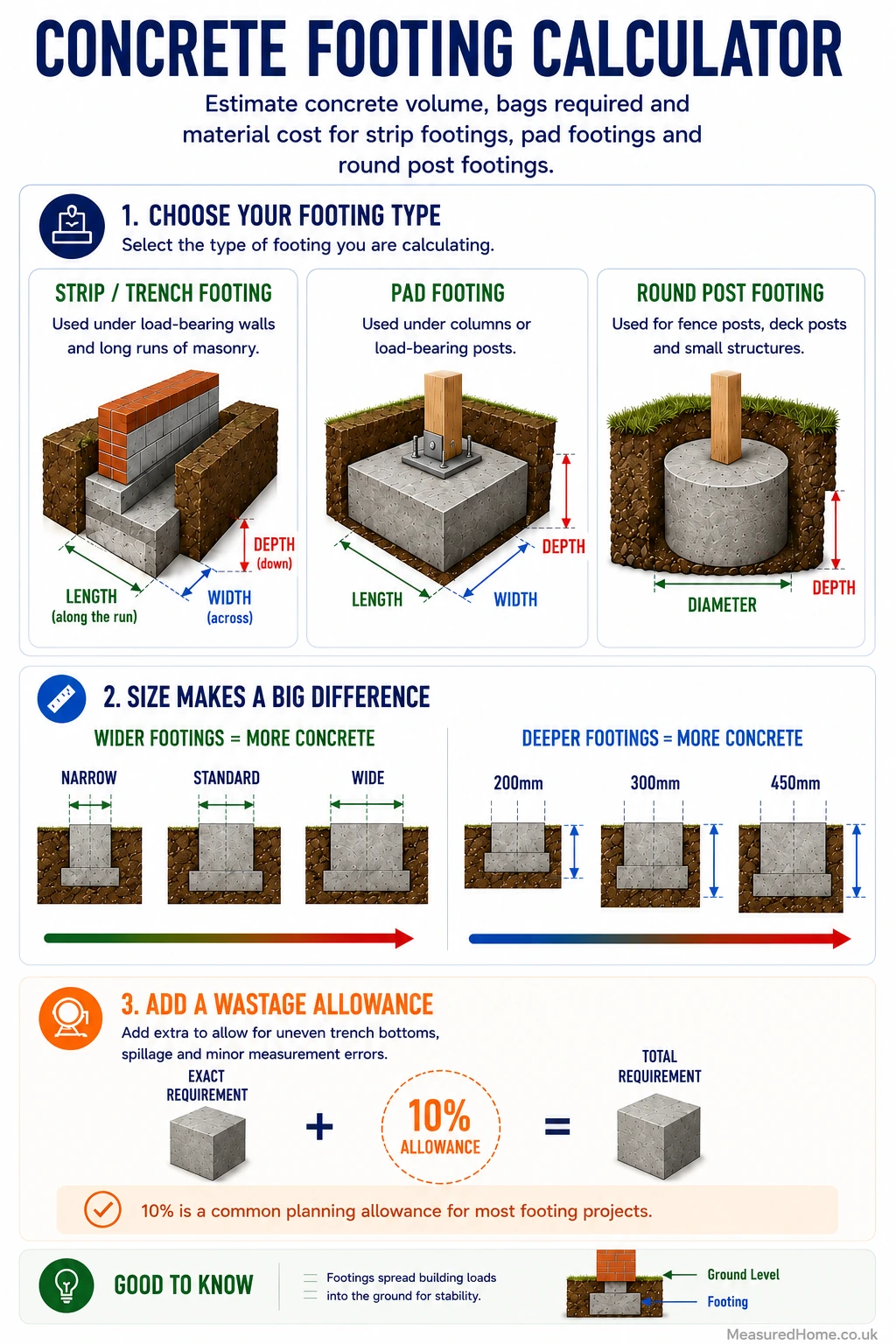
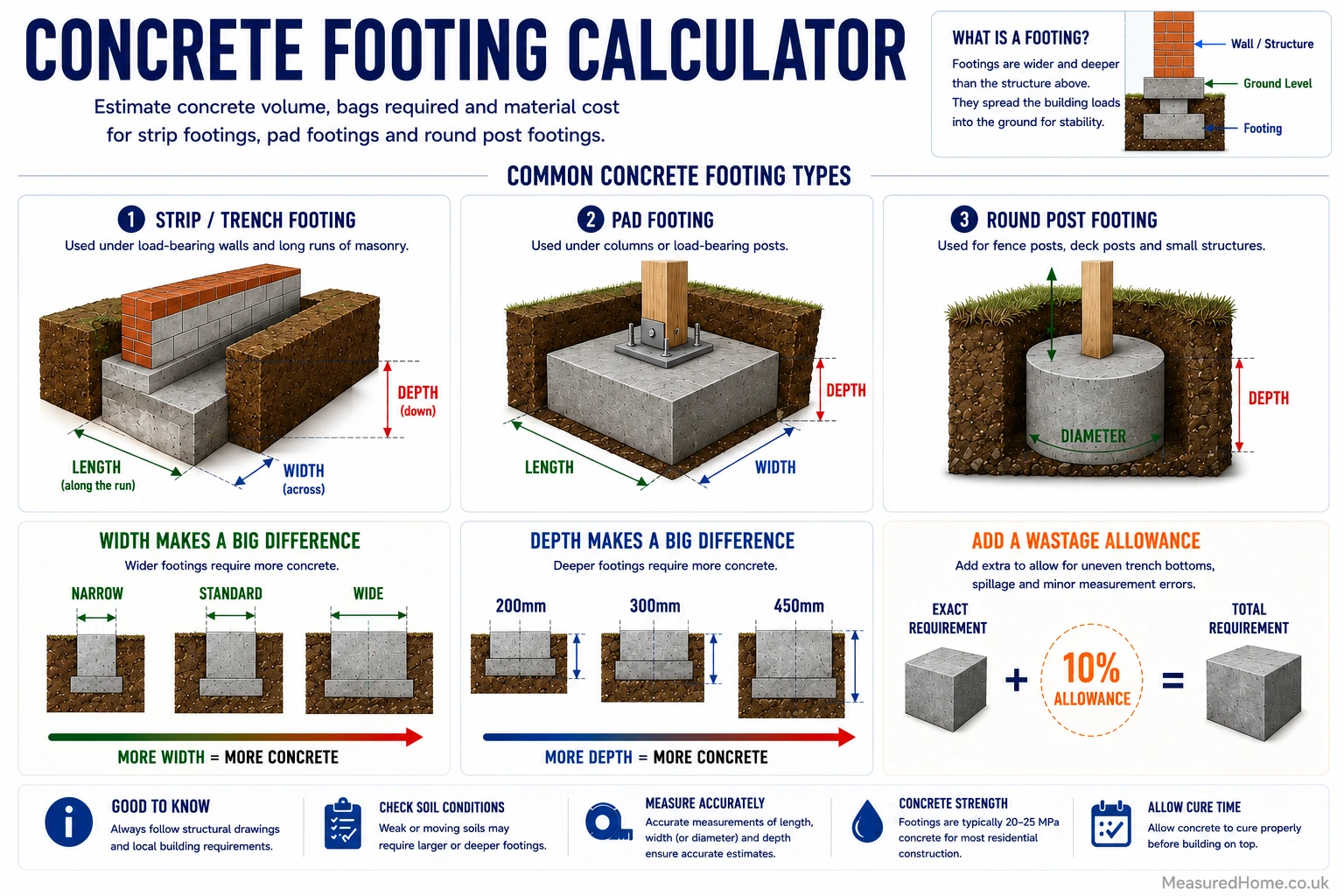
For strip or trench footings, enter the length, width and depth. For pad footings, enter the dimensions for one pad and use the quantity box for multiple matching pads. For round post footings, enter the diameter and depth, then add the number of holes. If you’re setting fence posts using Postcrete, use our Postcrete calculator instead.
The calculator supports metric and imperial inputs. In metric mode, rectangular footing length is entered in metres, while width and depth are entered in millimetres. Round footing diameter is entered in millimetres and round depth in metres.
Use the wastage field to allow for uneven excavations, over-digging, spillage and small measuring errors. The default is 10%, with a permitted range from 0% to 30%.
Results Explanation
After calculating, you will get the number of bags required, total bag weight where available, ready-mix volume and optional cost estimates.
Bag quantities are rounded up to the next whole bag. If you enter both a bag price and a ready-mix price, the calculator compares the two material costs only. Delivery charges, mixer hire, minimum order quantities and labour are not included. For a more detailed breakdown of bag quantities, supplied volume, total weight and leftover concrete, use our concrete bags calculator.
How the Maths Works
For strip and pad footings:
Volume = length × width × depth
For round post footings:
Volume = π × radius² × depth
The calculator converts all measurements into metres internally, then calculates the volume in cubic metres.
It then applies quantity:
Base volume = single footing volume × quantity
Next, it applies wastage:
Final volume = base volume × (1 + wastage ÷ 100)
Bag count is calculated from the selected bag yield:
Bags required = final volume ÷ bag yield
The result is rounded up to the next full bag.
Preset bag yields used by the calculator include:
- 20 kg bag ≈ 0.0095 m³
- 25 kg bag ≈ 0.012 m³
- 30 kg bag ≈ 0.014 m³
- 40 kg bag ≈ 0.019 m³
- 50 lb bag ≈ 0.0105 m³
- 60 lb bag ≈ 0.0096 m³
- 80 lb bag ≈ 0.017 m³
Ready-mix cost is based on the final volume with wastage. In metric mode, it uses £/m³. In imperial mode, it converts cubic metres to cubic yards.
Common Mistakes to Avoid
Do not use the calculator to choose footing sizes by guesswork. Footing depth and width depend on load, ground conditions, nearby trees, drains, frost risk and local requirements.
Avoid measuring only the neat design size if the trench is uneven. Real excavations often use more concrete than expected, which is why a wastage allowance is useful.
Do not forget the minimum order charges or delivery costs when comparing bags with ready-mix.
Avoid adding too much water to bagged concrete. It may make mixing easier, but it can weaken the final concrete.
FAQS
How deep should concrete footings be in the UK?
It depends on the structure, soil and site conditions. Guidance commonly refers to frost protection and suitable bearing ground; for example, NHBC guidance notes at least 450 mm below finished ground level in frost-susceptible soils. Structural work should be checked against drawings, engineer guidance or Building Control requirements.
Can I use this calculator for house foundations?
You can use it to estimate concrete volume, but not to design the foundation. House foundations are structural and should follow approved plans, soil conditions and professional guidance.
Is ready-mix better than bags for footings?
For small post footings or a single small pad, bags may be convenient. For larger strip footings or multiple pads, ready-mix can be faster and more consistent, although delivery access and minimum order costs matter.
How much wastage should I allow for footing concrete?
The calculator defaults to 10%, which is a sensible planning allowance for uneven trench bottoms, small errors and spillage. Very tidy formwork may need less, while rough excavations may need more.
Do I need Building Control approval for concrete footings?
Many structural projects do require Building Control involvement, especially extensions, load-bearing work and habitable buildings. Small garden projects may not, but you should check before pouring.
What footing types does this calculator support?
It supports strip/trench footings, pad footings and round post footings.
Does the calculator include reinforcement?
No. It estimates concrete volume, bags, bag weight and optional material cost only. If your footing design specifies reinforcement, use our rebar calculator to estimate the quantity, length and weight of rebar required.
Why does the calculator round bags up?
Concrete bags must be bought as whole bags, so the calculator rounds up to avoid under-ordering.
Related Calculators
Concrete Calculator
Concrete Mix Calculator
Concrete Column calculator
Concrete Weight Calculator
Disclaimer
This calculator is for estimating material quantities only. It does not confirm footing suitability, bearing capacity, concrete grade, reinforcement, drainage, inspection requirements or Building Control compliance. For structural work, use an engineer, approved drawings or competent professional advice.